|
||
| Sulphuric Acid on the WebTM | Technical Manual | DKL Engineering, Inc. |
Knowledge for the
Sulphuric Acid Industry

Sulphuric Acid on the Web
Introduction
General
Equipment Suppliers
Contractor
Instrumentation
Industry News
Maintenance
Acid
Traders
Organizations
Fabricators
Conferences
Used
Plants
Intellectual
Propoerty
Acid
Plant Database
Market
Information
Library
Technical Manual
Introduction
General
Definitions
Instrumentation
Plant Safety
Metallurgial
Processes
Metallurgical
Sulphur Burning
Acid Regeneration
Lead Chamber
Technology
Gas Cleaning
Contact
Strong Acid
Acid Storage
Loading/Unloading
Transportation
Sulphur
Systems
Liquid SO2
Boiler Feed Water
Steam Systems
Cooling Water
Effluent Treatment
Utilities
Construction
Maintenance
Inspection
Analytical Procedures
Materials of Construction
Corrosion
Properties
Vendor Data
DKL Engineering, Inc.
Handbook of Sulphuric Acid Manufacturing
Order
Form
Preface
Contents
Feedback
Sulphuric Acid
Decolourization
Order Form
Preface
Table of Contents
Process Engineering Data Sheets - PEDS
Order
Form
Table of Contents
Introduction
Bibliography of Sulphuric Acid Technology
Order Form
Preface
Contents


Sulphur Systems - Sulphur Pumps
January 16, 2003
Sulphur pumps are specially designed pumps to handle molten sulphur. The physical properties of sulphur are such that its viscosity can change rapidly over a small temperature change that can cause a pump motor to overload.

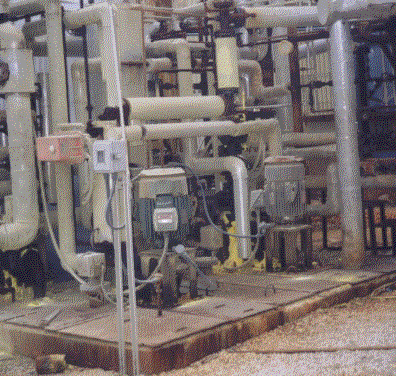
Lewis offers a specially designed vertical submerged centrifugal pump for molten sulphur service. In North America and elsewhere the world, Lewis pumps have virtually become the standard in the industry for the pumping of molten sulphur.
The impeller housing, shaft housing and discharge pipe are all steam jacketed to maintain the sulphur at its optimum pumping temperature. The sulphur temperature should never 158°C (317°F) at which point it begins to caramelize and becomes impossible to pump. Some impurities in sulphur can modify its viscosity characteristics so the optimum pumping temperature may be different from the recommend temperatures.
Lewis recommend that steam jacket be supplied with saturated dry steam at a maximum pressure of 35 psig (2.41 bar g). This corresponds to a steam temperature of 138°C (280°F). As the sulphur passes through the close internal running clearances of the pump its temperature will rise 14°C (28°F) due to friction. This results in a molten sulphur temperature of 152C (306F) which is still below the maximum allowable temperature.
Lewis pumps are available in a large range of sizes. Nearly any size pump available for sulphuric acid service can be supplied as a sulphur pump. The vendor should be contacted for large pump services but pumps as large as a Lewis size 8 are known to be available (see Appendix B).
Typical Lewis pump lengths are 84", 114" and 144" although standard units are available in lengths ranging from 7' to 22'.
Operation
Prior to putting a pump in service steam should be on the jacket for several hours which will allow all the pump parts to attain the normal operating temperature. The sulphur inside and outside the pump should be molten at the normal operating temperature.
Prior to starting the pump, the pump shaft should be rotated by hand to ensure that it is free to turn. Sulphur may freeze the pump shaft causing the motor to overload on startup.
The pump must be fully supplied with sulphur otherwise extensive damage may occur to the pump. During operation, a small amount of molten sulphur is pumped upward through and around the internal bearings lubricating them. Bypass passages are provided to return this sulphur back to the tank or pit.
Steam should always be supplied to any installed stand-by pumps to ensure they are ready to operate as required. The pump shafts should be rotated by hand on a regular basis to ensure it is free to turn and not frozen by sulphur. Pump shafts may freeze if the tank or pit is operated at low levels. Raising the sulphur level will sometimes be sufficient to melt the sulphur and free up the pump shaft.
Maintenance
When a pump is removed from service for maintenance it should be removed from the pit or tank and all sulphur should be drained from the pump casing. Attaching flexible stem hoses to the pump steam jackets will allow sulphur to drain freely from the pump as it is being lifted.
Once in the shop solid sulphur can be removed from the pump surfaces using a steam lance, wire brush or sandblasting. Never use a direct flame to remove sulphur as this will generate SO2 gas. Distortion or changes to the metal properties may occur if the part are heat by direct flame.
The following factors must be considered when sizing a sulphur pump.
- Flow rate
- Depth of sulphur pit or height of tank
- Line pressure drop, fittings, spray nozzle, valves, etc.
- Vertical distance from supply point to highest point in piping
- Tracing steam conditions
- Electrical current characteristics
- Operating pressure inside furnace

