|
||
| Sulphuric Acid on the WebTM | Technical Manual | DKL Engineering, Inc. |
Knowledge for the
Sulphuric Acid Industry

Sulphuric Acid on the Web
Introduction
General
Equipment Suppliers
Contractor
Instrumentation
Industry News
Maintenance
Acid
Traders
Organizations
Fabricators
Conferences
Used
Plants
Intellectual
Propoerty
Acid
Plant Database
Market
Information
Library
Technical Manual
Introduction
General
Definitions
Instrumentation
Plant Safety
Metallurgial
Processes
Metallurgical
Sulphur Burning
Acid Regeneration
Lead Chamber
Technology
Gas Cleaning
Contact
Strong Acid
Acid Storage
Loading/Unloading
Transportation
Sulphur
Systems
Liquid SO2
Boiler Feed Water
Steam Systems
Cooling Water
Effluent Treatment
Utilities
Construction
Maintenance
Inspection
Analytical Procedures
Materials of Construction
Corrosion
Properties
Vendor Data
DKL Engineering, Inc.
Handbook of Sulphuric Acid Manufacturing
Order
Form
Preface
Contents
Feedback
Sulphuric Acid
Decolourization
Order Form
Preface
Table of Contents
Process Engineering Data Sheets - PEDS
Order
Form
Table of Contents
Introduction
Bibliography of Sulphuric Acid Technology
Order Form
Preface
Contents

Sulphur Systems - Sulphur Filtration
September
19, 2006
Filtering of molten sulphur is required to remove solids that may plug sulphur spray nozzles or accumulate in catalyst beds giving rise to increases in pressure drop and shorter operating durations. Solid sulphur is generally stored outdoors and will collect dust and dirt from the surrounding environment. Storage indoors will help to minimize the accumulation of dust but will not totally prevent it. When the sulphur is melted it should be filtered and the clean sulphur placed into storage ready for use.
The removal of solids from molten sulphur is generally done using settlers and pressure filters.
An alternative to sulphur filtration is a settling pit designed with sufficient residence time to allow suspended solids to settle out of the molten sulphur. Settling pits are generally concrete with or without acid resistant brick lining. Steam coils are arranged in the pit to maintain the sulphur in the molten state. The pit is designed for low velocities to allow the solids to settle to the bottom of the pit. The principles used in the design is similar to a gravity settler used to remove solids from a gas. The dirty sulphur is added at one end of the pit and removed at the far end. The clean sulphur is removed from the pit by overflowing a weir into a storage or pump pit. The nature of the settler operation requires a large plot area for the pit. Often two settlers are installed so that while one is in operation, the other pit is being cleaned.
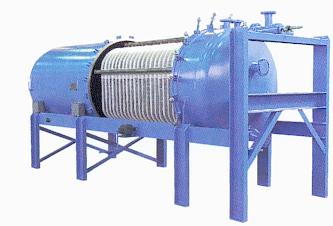
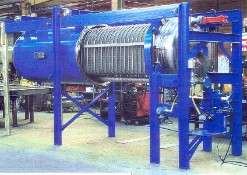
Sulphur filters vary in size and complexity and are usually individually designed for each application. Several suppliers offer sulphur filters and each have their own modes of operation. Typically, a filter vessel is a horizontal cylindrical vessel with a steam jacket to maintain the sulphur in the molten state. The filter leaves stand on a centrally located header. There are two type of filters classified as to how the filter is opened for cleaning. The first type of filter is designed so that the body pulls back from the head for cleaning while the front head and filter bundle remain stationary. This type of filter is most frequently used because the pipework, if it goes in and out of the head, does not need to be disconnected. The second style of filter opens by moving the head and filter bundle. Connections to the head must be made using flexible hose or slip type joints. The problems is ensuring that slip type joints seal properly.
The filter cake can be air or steam dried so it stays on the leaves whilst the body is withdrawn and then shaken off the leaves with an air vibrator into a catcher below.
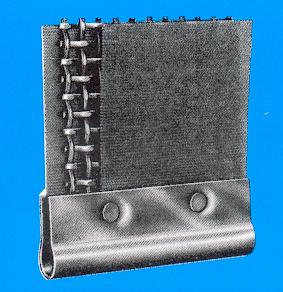
The leaves are usually a stainless steel woven cloth supported on a perforated stainless steel backing plate. The leaves have to be precoated, before filtration commences, with a filter aid. This filter aid can be added directly to the dirty pit or via a separate pre-coat pit. The sulphur is pumped from the pit to the filter and back again until the leaves are precoated then the filtered sulphur is diverted to the process or clean sulphur storage. In critical applications, two filters may be installed with one acting as a spare.
- Filtration rates vary from ½ to 1 ton/ft²/day depending on the quality of the sulphur being filtered. Cycle times can also vary widely depending on the amount of dirt being filtered.
- Consumption of precoat (diatomaceous earth) will be approximately 20 lb/100 ft² of filtration area. Some vendors recommend 10 to 15 lb/100 ft². The amount of precoat required will depend on how evenly it can be distributed on the surface of the filter leaves. A precoat loading of 10 lb/100 ft² will result in a precoat thickness of 1/16” if it is evenly distributed across the filter surface.
- Precoat rate should be a minimum of 16 USGPH/ft² of filtration area. Maximum precoat rate will be about 35 USGPH/ft².
- A filter having a filtration area of 260 ft² will have a cake capacity of about 34 ft³.
The following are general requirements for the mechanical design of a sulphur filter.
- Sulphur filters are pressure vessels and as such should be designed to the applicable codes and regulations such as ASME Section VIII, Division 1.
- A corrosion allowance of at least 3 mm (1/8”) should be incorporated in the design.
- Design pressure for the unit should be appropriate for the operating pressure. A design pressure of 10.3 bar @ 140°C (150 psi @ 284°F) will be suitable for most applications and is a standard for most manufacturers.
- The steam jacket should be design for an operating pressure of 3.1 bar (45 psi). A pressure relief valve is required on both the head and shell sections to protect the steam jacket from excessive pressure.
- Shell Material of Construction: Carbon Steel
- Internals: 316 Stainless Steel
- To facilitate quick and easy opening of the filter for cake discharge and cleaning, the filter housing should be equipped with a quick open closure system and a mechanism to retract the housing.
- Insulation is required for heat conservation and personnel protection. Typically, 50 mm (2”) of calcium silicate insulation will be required. The insulation should be protected by aluminum or stainless steel cladding having a minimum thickness of 0.4 mm (0.016”).
- An overhead support frame is preferred since it avoids the possibility of sulphur discharging onto the support frame when the shell is retracted for cake discharge and cleaning.
Filter leaves come in a variety of sizes, designs and construction depending on the application. For sulphur filtering applications, the filter leaves should be constructed of stainless steel. The filter leaf will be constructed of 3, 5 or 7 layers of screen and mesh. The design of the leaf will depend on the filtration requirements, pressure drop requirements, flow of filtrate through the leaf, etc.
The construction of the filter and leaves should allow for easy removal and replacement of the leaves.