|
||
| Sulphuric Acid on the WebTM | Technical Manual | DKL Engineering, Inc. |
Knowledge for the
Sulphuric Acid Industry

Sulphuric Acid on the Web
Introduction
General
Equipment Suppliers
Contractor
Instrumentation
Industry News
Maintenance
Acid
Traders
Organizations
Fabricators
Conferences
Used
Plants
Intellectual
Propoerty
Acid
Plant Database
Market
Information
Library
Technical Manual
Introduction
General
Definitions
Instrumentation
Plant Safety
Metallurgial
Processes
Metallurgical
Sulphur Burning
Acid Regeneration
Lead Chamber
Technology
Gas Cleaning
Contact
Strong Acid
Acid Storage
Loading/Unloading
Transportation
Sulphur
Systems
Liquid SO2
Boiler Feed Water
Steam Systems
Cooling Water
Effluent Treatment
Utilities
Construction
Maintenance
Inspection
Analytical Procedures
Materials of Construction
Corrosion
Properties
Vendor Data
DKL Engineering, Inc.
Handbook of Sulphuric Acid Manufacturing
Order
Form
Preface
Contents
Feedback
Sulphuric Acid
Decolourization
Order Form
Preface
Table of Contents
Process Engineering Data Sheets - PEDS
Order
Form
Table of Contents
Introduction
Bibliography of Sulphuric Acid Technology
Order Form
Preface
Contents

Contact Section
May 8, 2003
| Introduction | Associated
Links
Blowers |
In the late 1800’s and early 1900’s, the rapid advancement of industry gave rise to a fast growth in demand for sulphuric acid. The ‘lead chamber’ process was up to that point the main method of sulphuric acid production. Research was undertaken to develop a process whereby sulphur dioxide (SO2) and oxygen (O2) are reacted together in the presence of a catalyst to form sulphur trioxide (SO3). The so-called ‘contact process’ came into initial use with platinum as the catalyst on which the conversion of SO2 to SO3 took place. Platinum catalysts are highly active but suffered from high costs and were easily poisoned by contaminants such as As2O3. In 1913, BASF patented a catalyst using vanadium pentoxide and alkali metal oxides on porous carriers containing silica. In 1915, a commercial scale plant began production of sulphuric acid using vanadium catalyst. This was the beginning of the modern contact process.
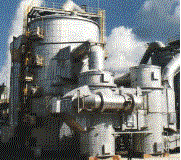
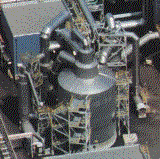
The contact section of a modern day acid plant comprises all the dry gas handling equipment including the blower, gas-to-gas heat exchangers, converter, ducting and stack.