|
||
| Sulphuric Acid on the WebTM | Technical Manual | DKL Engineering, Inc. |
Knowledge for the
Sulphuric Acid Industry

Sulphuric Acid on the Web
Introduction
General
Equipment Suppliers
Contractor
Instrumentation
Industry News
Maintenance
Acid
Traders
Organizations
Fabricators
Conferences
Used
Plants
Intellectual
Propoerty
Acid
Plant Database
Market
Information
Library
Technical Manual
Introduction
General
Definitions
Instrumentation
Plant Safety
Metallurgial
Processes
Metallurgical
Sulphur Burning
Acid Regeneration
Lead Chamber
Technology
Gas Cleaning
Contact
Strong Acid
Acid Storage
Loading/Unloading
Transportation
Sulphur
Systems
Liquid SO2
Boiler Feed Water
Steam Systems
Cooling Water
Effluent Treatment
Utilities
Construction
Maintenance
Inspection
Analytical Procedures
Materials of Construction
Corrosion
Properties
Vendor Data
DKL Engineering, Inc.
Handbook of Sulphuric Acid Manufacturing
Order
Form
Preface
Contents
Feedback
Sulphuric Acid
Decolourization
Order Form
Preface
Table of Contents
Process Engineering Data Sheets - PEDS
Order
Form
Table of Contents
Introduction
Bibliography of Sulphuric Acid Technology
Order Form
Preface
Contents

Sulphuric Acid Plant Safety - Sulphuric
Acid/Oleum
November 3, 2003
|
Introduction Eye/Face Protection Protective Clothing Safety Signs |
Associated Links |
Sulfuric acid is a clear, colourless to dark brown, odourless, dense, oily
liquid. It will not burn but it can decompose at high temperatures forming toxic
gases, such as sulfur oxides. Contact of sulfuric acid with
combustible materials may cause fire. It is considered to be highly
reactive. Contact with many organic and inorganic chemicals may cause fire
or explosion and contact with metals liberates flammable hydrogen gas. It also
reacts violently with water.
Sulfuric acid is VERY TOXIC. It may be fatal if inhaled or swallowed and
it is CORROSIVE to the eyes, skin and respiratory tract. It may cause blindness
and permanent scarring. It also causes lung injury and these effects may
be delayed. Strong inorganic acid mists containing sulfuric acid are
CARCINOGENIC.
To protect your eyes from sulphuric acid, chemical safety goggles must be worn at all times in designated areas. A face shield may also be necessary when handling sulfuric acid in an open system.
| Acid Concentration | > 8
hour Recommended |
> 4
hour Recommended |
1 to
4 hour Use with Caution |
< 1
hour Not Recommended |
| Sulphuric Acid, Fuming | Saranex™ Responder® Barricade® TrellChem® HPS |
Teflon™ Tychem® 10000 |
Polyvinyl | Polyvinyl
alcohol CPF® 3 |
| >70 wt% Sulphuric Acid | Butyl rubber polyethylene Teflon™ Saranex™ 4H™ Barricade® CPF® 3 Responder® TrellChem® HPS Tychem® 10000 |
Viton™ |
Neoprene polyvinyl chloride Viton™ |
Natural
rubber nitrile rubber polyvinyl alcohol |
| 30 to 70 wt% Sulphuric Acid | Butyl rubber natural rubber neoprene polyethylene polyvinyl chloride Teflon™ Saranex™ Barricade® Responder® 4H™ CPF® 3 Viton™ TrellChem® HPS Tychem® 10000 |
- | Nitrile rubber | Polyvinyl alcohol |
| <30 wt% Sulphuric Acid | Butyl rubber natural rubber neoprene polyethylene polyvinyl chloride Teflon™ Viton™ Barricade® Responder® Saranex™ 4H™ CPF® 3 TrellChem® HPS Tychem® 10000 |
- | - | Polyvinyl
alcohol. |
Notes:
1. Recommendations are NOT valid for very thin Natural rubber,
Neoprene, Nitrile and PVC gloves (0.3 mm or less).
2. Recommendations are valid for permeation rates reaching 0.1
µg/cm2/min or 1 mg/m2/min and over. Resistance of
specific materials can vary from product to product. Breakthrough times
are obtained under conditions of continuous contact, generally at room
temperature. Evaluate resistance under conditions of use and maintain
clothing carefully.
Saranex™ is a trademark of the Dow Chemical Company
Tychem® is a registered trademark of DuPont
CPF® 3 is a registered trademark of DuPont
Barricade® is a registered trademark of DuPont
TrellChem® is a registered trademark of Trelleborg, Sweden
Responder® is a registered trademark of Kappler
Reference: Forsberg, K., et al. Quick selection guide to chemical
protective clothing. 3rd edition. Van Nostrand Reinhold, 1997.
Safety Signs
| General warning sign for sulphuric acid. | 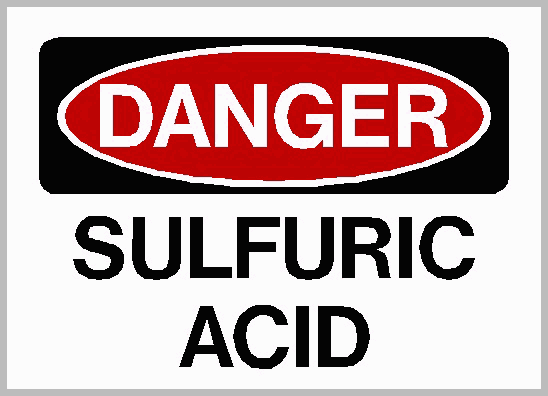 |
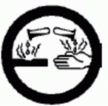
| General warning sign for corrosive material. | 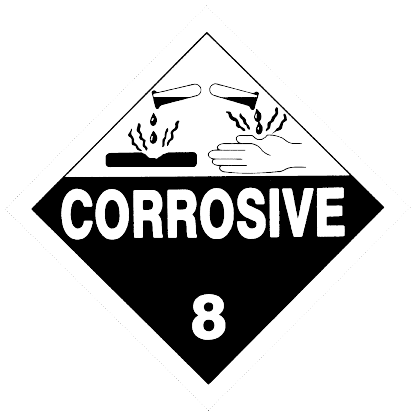 
 |
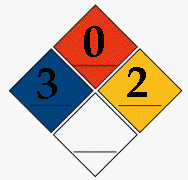
| The National Fire Protection
Association - NFPA 704 uses a symbol system designed as a diamond-shaped
label containing four differently colored squares. A number (0 - 4) or an
abbreviation is added to each square indicating the order of hazard
severity. The higher the number, the greater the hazard. Flammability (Red) - 0 - Will not burn Health Hazard (Blue) - 3 - Extreme danger Reactivity (Yellow) - 2 - Violent reaction with water Special Hazard (White) - None
There are only two NFPA 704 approved symbols for Special Hazards: OX
(oxidizer) and |
 |

