|
||
| Sulphuric Acid on the WebTM | Technical Manual | DKL Engineering, Inc. |
Knowledge for the
Sulphuric Acid Industry

Sulphuric Acid on the Web
Introduction
General
Equipment Suppliers
Contractor
Instrumentation
Industry News
Maintenance
Acid
Traders
Organizations
Fabricators
Conferences
Used
Plants
Intellectual
Propoerty
Acid
Plant Database
Market
Information
Library
Technical Manual
Introduction
General
Definitions
Instrumentation
Plant Safety
Metallurgial
Processes
Metallurgical
Sulphur Burning
Acid Regeneration
Lead Chamber
Technology
Gas Cleaning
Contact
Strong Acid
Acid Storage
Loading/Unloading
Transportation
Sulphur
Systems
Liquid SO2
Boiler Feed Water
Steam Systems
Cooling Water
Effluent Treatment
Utilities
Construction
Maintenance
Inspection
Analytical Procedures
Materials of Construction
Corrosion
Properties
Vendor Data
DKL Engineering, Inc.
Handbook of Sulphuric Acid Manufacturing
Order
Form
Preface
Contents
Feedback
Sulphuric Acid
Decolourization
Order Form
Preface
Table of Contents
Process Engineering Data Sheets - PEDS
Order
Form
Table of Contents
Introduction
Bibliography of Sulphuric Acid Technology
Order Form
Preface
Contents


Metallugical Processes
May 25, 2013
|
Introduction SO3 Formation |
Associated Links |
There are a variety of metallurgical process generating off-gases containing a variety of SO2 concentrations and impurities. Each process is unique which dictates that the gas be treated in different ways in order to remove impurities and treat the SO2 in the gas. The following table list the type of metallurgical operation and the type of hot gas cleaning employed prior to sending the gas to a sulphuric acid plant or in some cases an alternate treament method.
| Operation | Metal | Gas Source | Hot Gas Cleaning System | SO2 Fixation | |||||||||
| Ashio Smelter Furukawa Co. Ltd. Japan |
Copper | Flash Furnace | Waste Heat Boiler | Cyclones | Hot ESP's | Acid Plant | |||||||
|
Utah Copper Division Kennecott Minerals Co. Utah, USA |
Copper | Noranda Reactors | Waste Heat Boiler | Cyclone | Hot ESP's | Hot Gas Fan | Acid Plant | ||||||
| PS Converters | Gravity Settling Chamber | Heat Exchanger | Hot Gas Fan | ||||||||||
| Philippine Associated Smelting & Refining Corp. | Copper | Flash Smelting | Waste Heat Boiler | Cyclone | Hot ESP | Acid Plant | |||||||
| Converters | Waste Heat Boiler | ESP | |||||||||||
| Tamano Smelter HIBI Kyodo Smelting Co. Ltd. Japan |
Copper | Flash Smelting | Waste Heat Boiler | Acid Plant | |||||||||
|
Saganoseki Nippon mining Co. Ltd. Japan |
Copper | Flash Smelting | Waste Heat Boiler | Hot ESP's | Acid Plant | ||||||||
| Converter | Waste Heat Boiler | Hot ESP's | |||||||||||
| Horne Smelter Xstrata Copper Canada |
Copper | Noranda Reactor | Spray Chamber | Hot Gas Fan | Acid Plant | ||||||||
|
Hudson Bay Mining and Smelting Flin Flon, Manitoba Canada |
Copper | Roasters | Hot ESP | None | |||||||||
| Reverb | Hot ESP | Bag House | |||||||||||
| Fuming Furnace | Bag House | ||||||||||||
|
Cananea Smelter Compania minera de Cananea S.A. |
Copper | Reverb | Spray Chamber | ||||||||||
| Converters | Gravity Settling Chamber | ||||||||||||
| BCL Nickel
Smelter Bamangwato Concessions Limited |
Nickel | Flash Smelting | Waste Heat Boiler | Hot ESP | Hot Gas Fan | Stack | |||||||
| Kalgoorlie
Nickel Smelter BHP Billiton |
Nickel | Flash Smelting | Waste Heat Boiler | Hot ESP | Acid Plant | ||||||||
| P.T. Inco Indonesia |
Nickel | PS Converters | Gravity Settling Chamber | Spray Chamber | Hot ESP | Hot Gas Fan | Stack | ||||||
| Thompson
Smelter INCO Canada |
Nickel | Roasters | Cyclone | Hot ESP | None | ||||||||
|
Hidalgo Smelter Phelps Dodge Corporation |
Copper | Flash Smelting | Wste Heat Boiler | Hot ESP | Hot Gas Fan | Acid Plant | |||||||
| Converters | Waste Heat Boiler | Gravity Settling Chamber | Hot ESP | Hot Gas Fan | |||||||||
| Brunswick Mining and Smelting Corporation Limited | Lead | Sinter | Hot ESP | Acid Plant | |||||||||
| Boliden Odda Zinc | Zinc | Fluid Bed Roaster | Waste Heat Boiler | Acid Plant | |||||||||
| Mikkaichi
Smelter Nikko Zinc Co. Ltd. |
Zinc/Lead | Sinter | Hot ESP | Spray Chamber | Wet ESP | Stack | |||||||
| Hachinohe Smelting Company Ltd. | Zinc | Sinter | Hot Gas Fan | Hot ESP | Acid Plant | ||||||||
| Amax Zinc
Company Illinois, USA |
Zinc | Roasters | Waste Heat Boiler | Cyclone | Hot ESP | Acid Plant | |||||||
| Harjavalta Copper Smelter | Copper | Flash Smelting | Waste Heat Boiler | Hot ESP | Hot Gas Fan | Acid Plant | |||||||
| Converters | Waste Heat Boiler | ||||||||||||
| Copper Cliff
Smelter Vale |
Copper | Flash Smelting | Spray Chamber | Heat Exchanger | |||||||||
| Xstrata Nickel Sudbury, Canada |
Copper/Nickel | Roaster | Primary Cyclones | Secondary Cyclones | Heat Exchanger | Hot ESP | Hot Gas Fan | Acid Plant | |||||
Smelting of sulphide ores results in large amounts of SO2 being produced. Modern smelting processes use oxygen enrichment to generate off-gases containing from 15% to 80% SO2. Unfortunately, the increase in SO2 concentration results in higher SO3 concentrations in the flue gases.
Higher SO3 concentrations leads to the formation of sulphate and sulphuric acid in the downstream gas handling systems causing corrosion of the equipment. As well, larger amounts of SO3 reporting to the wet gas cleaning system resulting in higher treatment costs for the effluent treatment system and larger wet electrostatic precipitators for the final removal of SO3 prior to the contact section of the sulphuric acid plant.
The oxidation of SO2 to SO3 can occur by one of two process:
The formation of SO3 by homogeneous reaction occurs primarily at temperatures above 1200°C (2192°F) which are only present in the flame. The process is dependent on the flame temperature and amount of excess oxygen. The use of tonnage oxygen increases oxygen concentrations and flame temperatures leading to an increase in SO3 content.
Catalytic oxidation of SO2 to SO3 take place at temperatures below 700°C (1292°F) in the presence of a catalyst. It is known that vanadium pentoxide (V2O5) and iron oxide (Fe2O3) acts as catalyst for the reaction. These materials can be found in the ash, dust and deposits found throughout the hot off-gas handling system. Fortunately, the reaction rates are slow and the SO3 concentrations obtained are nowhere near the equilibrium values possible.
One source states that 1 to 3% of the SO2 in the gas is converted to SO3. Formation of SO3 appear to be maximized at temperatures between 570 to 640°C (1060-1185°F). The equilibrium conversion of SO2 to SO3 is small at high temperatures but the equilibrium SO3 increases rapidly as the gas is diluted and cooled. The actual SO3 formed is determined by the rate of reaction and the time available for the reaction to take place. At lower temperatures thermodynamics favour the formation of more SO3 but the reaction rates are slow. Therefore, SO3 formation can be minimized by rapid cooling of the gas.
The following general observations have been made about the formation of SO3:
When SO3 and H2O are present in the gas they react together quickly to form gaseous sulphuric acid (H2SO4). The equilibrium conversion of this reaction is a function of temperature as illustrated in the following chart. The data is for a water partial pressure of 0.034 atm and where H2O is present in large excess compared to SO3.
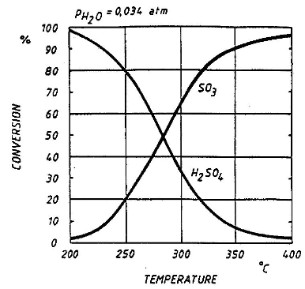
The formation of H2SO4 is a problem in the flue gas system when it condenses onto the surface of equipment where the temperature is below the dewpoint of the gas. The dewpoint depends on the partial pressure of gaseous H2O and H2SO4.

