|
||
| Sulphuric Acid on the WebTM | Technical Manual | DKL Engineering, Inc. |
Knowledge for the
Sulphuric Acid Industry

Sulphuric Acid on the Web
Introduction
General
Equipment Suppliers
Contractor
Instrumentation
Industry News
Maintenance
Acid
Traders
Organizations
Fabricators
Conferences
Used
Plants
Intellectual
Propoerty
Acid
Plant Database
Market
Information
Library
Technical Manual
Introduction
General
Definitions
Instrumentation
Plant Safety
Metallurgial
Processes
Metallurgical
Sulphur Burning
Acid Regeneration
Lead Chamber
Technology
Gas Cleaning
Contact
Strong Acid
Acid Storage
Loading/Unloading
Transportation
Sulphur
Systems
Liquid SO2
Boiler Feed Water
Steam Systems
Cooling Water
Effluent Treatment
Utilities
Construction
Maintenance
Inspection
Analytical Procedures
Materials of Construction
Corrosion
Properties
Vendor Data
DKL Engineering, Inc.
Handbook of Sulphuric Acid Manufacturing
Order
Form
Preface
Contents
Feedback
Sulphuric Acid
Decolourization
Order Form
Preface
Table of Contents
Process Engineering Data Sheets - PEDS
Order
Form
Table of Contents
Introduction
Bibliography of Sulphuric Acid Technology
Order Form
Preface
Contents


Maintenance and Inspection - Converter
September 10, 2003
|
Introduction Insulation Gas Leaks General Housekeeping Corrosion and Scaling |
Associated Links |
Most maintenance and inspection of a converter can only be done during an extended shutdown where there is enough time to purge and cool down the plant to the point where the vessel can be opened up for entry.
Deteriorated, improperly
installed, and/or insufficient thickness of thermal insulation and cladding
could cause uneven temperatures across the converter. The may cause
unexpected thermal stresses in the converter that may leak to damage.
The surface of insulation must be
kept thoroughly sealed to prevent infiltration of water or circulation of air
behind the insulation. This may lead to high rates of external corrosion
which will lead to premature failure of the vessel.
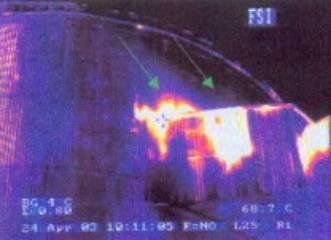
An effective way of monitoring the effectiveness of thermal insulation is to take thermal images of the vessel during operation. These images will reveal ‘hot spots’ which indicate area where the insulation has failed. These areas must be repaired as soon as possible.
Whenever maintenance is done on the converter that required that insulation and cladding be removed, the insulation and cladding must be reinstalled to ‘as-new’ condition prior to restarting the plant.
Gas can escape a converter when a
mechanical failure of a part of the converter results in a leak to the
environment. Mechanical failures are generally a result of thermal
stresses on the converter that cause welds or joints to fail. All
gas leaks should be repaired as soon as possible.
Locating the exact point of the
gas leak will be a problem since the gas may have travel under the insulation
and cladding prior to emerging at the ‘leak point’. Insulation and
cladding must be removed until the source of the leak is found. The most
likely location of the leaks is in and around gas nozzles which are areas under
a lot of stress due to thermal stresses and forces from the ducting and nozzles.
Repair of the leak must be done
during a plant shutdown since it will not be possible to weld in the area due to
the escaping gas. Prior to repairing the leak, the cause of the leak
should be investigated to determine the probable cause(s). The repair
should not only seal the leak but also address the cause so the leak will not
re-occur.
After any maintenance inside the
converter all dirt, dust, scale, etc. must be swept up and vacuumed from the
inside of the converter. Any loose material inside the converter may be
picked up by the gas and carried into the catalyst bed where it will contribute
to premature pressure increases across the catalyst.
Catalyst support screens must
also be clean and be free of dirt and scale.
There have been a few instances
of excessive scaling of 304 SS reported in metallurgical plant operations.
The exact mechanism of scale formation is not known but it is suspected that
high operating temperature, high sulphur dioxide concentrations, present of
nitric oxides play some role in the scaling phenomenon.
During the annual shutdown, the
converter should be inspected for excessive scaling and corrosion.
Thickness measurements should be taken at key locations on the shell, floor,
roof and division plates so the progress of any scaling and corrosion can be
monitored.
Any scale found should be sampled
and analysed to determine the type of scaling or corrosion that is occurring.

