|
||
| Sulphuric Acid on the WebTM | Technical Manual | DKL Engineering, Inc. |
Knowledge for the
Sulphuric Acid Industry

Sulphuric Acid on the Web
Introduction
General
Equipment Suppliers
Contractor
Instrumentation
Industry News
Maintenance
Acid
Traders
Organizations
Fabricators
Conferences
Used
Plants
Intellectual
Propoerty
Acid
Plant Database
Market
Information
Library
Technical Manual
Introduction
General
Definitions
Instrumentation
Plant Safety
Metallurgial
Processes
Metallurgical
Sulphur Burning
Acid Regeneration
Lead Chamber
Technology
Gas Cleaning
Contact
Strong Acid
Acid Storage
Loading/Unloading
Transportation
Sulphur
Systems
Liquid SO2
Boiler Feed Water
Steam Systems
Cooling Water
Effluent Treatment
Utilities
Construction
Maintenance
Inspection
Analytical Procedures
Materials of Construction
Corrosion
Properties
Vendor Data
DKL Engineering, Inc.
Handbook of Sulphuric Acid Manufacturing
Order
Form
Preface
Contents
Feedback
Sulphuric Acid
Decolourization
Order Form
Preface
Table of Contents
Process Engineering Data Sheets - PEDS
Order
Form
Table of Contents
Introduction
Bibliography of Sulphuric Acid Technology
Order Form
Preface
Contents


Maintenance and Inspection - Blower
September 8, 2003
|
Introduction Maintenance and Inspection Schedule Impeller Washing Lubrication System Shutdowns Electric Motor Problems |
Associated Links |
The manufacturer’s maintenance procedures and recommendations should be reviewed and strictly adhered to in order to ensure the proper operation of the equipment. The following is provided as a general guideline only.
Maintenance and Inspection Schedule
| Shift |
|
| Daily |
|
| Weekly |
|
| Monthly |
|
| Shutdown |
Every year, the following should be done during the shutdown:
Every
two (2) years, the following should be done during the shutdown:
|
During normal operation deposits may form on the
impeller and in the area between the back of the impeller and the scroll
housing. These deposits may lead to high vibrations in the compressor
leading to a blower and plant shutdown. This problem generally
occurs as a result of poor mist elimination at the top of the drying tower.
When an imbalance occurs due to deposits forming on the impeller, the blower must be shutdown and the impeller and casing washed to remove the deposits.
There may be times when the blower is not operated for extended periods of time such as during the annual plant shutdown. To prevent damage to the blower the following actions must be taken:
The manufacturer’s recommended oil must be used for
the compressor. Under no circumstances may anti-foaming additives
(molybdenum disulphide and/or high pressure additives) be added later. The
use of lubrication oils other than the manufacturer’s recommended oil may void
any warranties on the machine.
All attempts must be made to avoid getting dust,
dirt, scale, fibres, etc. in to the lubrication oil and system. Use
lint-free cloths for cleaning.
Any new lube oil piping must be pickled prior to
installation to ensure the insides are free of scale and dirt.
Any new oil added to the system to make-up for
losses must be of the same quality used in the machine. Oil must never be
added directly to the reservoir but must be poured through a fine-mesh screen.
Records should be kept of the oil type, manufacturer, quantity added, filling
dates, etc.
Maintenance of the electric motor will depend on
the duty that the motor has been subjected to including the ambient temperature,
stopping and starting frequency, atmospheric air quality, etc. Maintenance
on the motor will include such activities as:
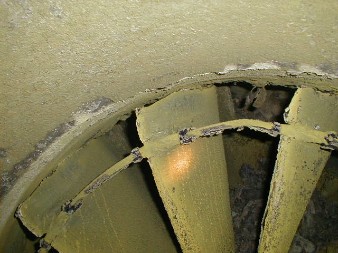
| Impeller Corrosion/Erosion Corrosion or erosion of a blower impeller can occur when there is excessive carry over of acid mist/droplets from the outlet of a drying tower due to poor mist eliminator performance or acid distribution problems. Deposits may form on the blades resulting in high vibrations and reduced bearing life. Impellers should be inspected during each plant turnaround and more often if excessive vibrations are observed. Washing the impeller on a regular basis will remove the buildup of solids that lead to high vibrations but the cause of the deposits should be fixed to prevent further buildup. The performance and condition of the drying tower mist eliminators should be monitored. The easiest way to monitor their performance is to do regular stick tests at the exit of the tower.
|
|