|
||
| Sulphuric Acid on the WebTM | Technical Manual | DKL Engineering, Inc. |
Knowledge for the
Sulphuric Acid Industry

Sulphuric Acid on the Web
Introduction
General
Equipment Suppliers
Contractor
Instrumentation
Industry News
Maintenance
Acid
Traders
Organizations
Fabricators
Conferences
Used
Plants
Intellectual
Propoerty
Acid
Plant Database
Market
Information
Library
Technical Manual
Introduction
General
Definitions
Instrumentation
Plant Safety
Metallurgial
Processes
Metallurgical
Sulphur Burning
Acid Regeneration
Lead Chamber
Technology
Gas Cleaning
Contact
Strong Acid
Acid Storage
Loading/Unloading
Transportation
Sulphur
Systems
Liquid SO2
Boiler Feed Water
Steam Systems
Cooling Water
Effluent Treatment
Utilities
Construction
Maintenance
Inspection
Analytical Procedures
Materials of Construction
Corrosion
Properties
Vendor Data
DKL Engineering, Inc.
Handbook of Sulphuric Acid Manufacturing
Order
Form
Preface
Contents
Feedback
Sulphuric Acid
Decolourization
Order Form
Preface
Table of Contents
Process Engineering Data Sheets - PEDS
Order
Form
Table of Contents
Introduction
Bibliography of Sulphuric Acid Technology
Order Form
Preface
Contents


Contact Section -
Stacks
- Erection
January 18, 2003
|
Introduction |
Associated Links |
The following sequnce of pictures illustrates the lifting and erection of an acid plant stack.
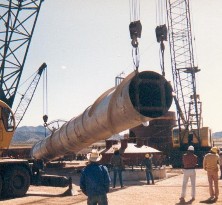 |
Lifting of any large piece of
equipment is a dangerous operation. Countless things can go wrong if the
lift is not planned and executed properly. An acid plant stack is often the
first major piece of equipment to be erected since this provide better
access for the large cranes required. A stack lift is not a heavy lift but its length does make it an event to be watched. |
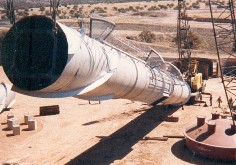 |
In this case three cranes are used
to perform the lift. One crane is use at the base of the stack to lift and
guide the bottom. Two cranes are used at the top of the stack the perform
the lift. A frame work is used in the inside of the stack to attach the liftng cables. This ensure that the top of the stack is not damaged during the lift. Generally, as much of the platforms and ladders are attched to the stack while it is still on the ground since it is easier and safer to perform the work on the ground than after the stack is erected. |
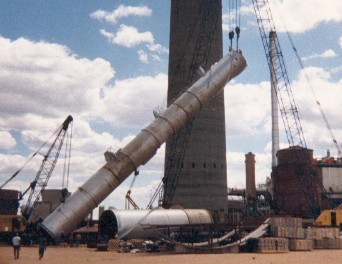 |
The stack must be design properly so the no damage to the stack occurs when it is first lifted. Normally, a stack is subjected to wind loads, earthquake loads, etc. When a stack is first lifted from the horizontal position there is a risk that the stack will buckle in the middle. The walls of the stack must be thick enough to prevent this buckling. Reinforcing rings are also utilized to ensue that the stack does not buckle. |
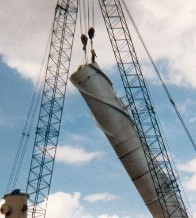 |
As the stack comes to the vertical position the crane at the bottom must guide the base of the stack to its foundation. |
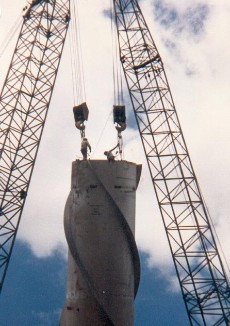 |
During this lift workers were stationed at the top of the stack. This is not normal practice and posses a risk to the workers. Eventually workers will be required at the top of the stack to release the lifting cable and remove the lifting frame. |
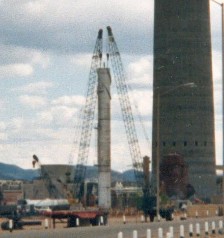 |
The stack is finally lifted in the vertical position and is guided on to the foundation. The cranes will remain attached to the stack until the base of the stack is secured to the foundation. |

