|
||
| Sulphuric Acid on the WebTM | Technical Manual | DKL Engineering, Inc. |
Knowledge for the
Sulphuric Acid Industry

Sulphuric Acid on the Web
Introduction
General
Equipment Suppliers
Contractor
Instrumentation
Industry News
Maintenance
Acid
Traders
Organizations
Fabricators
Conferences
Used
Plants
Intellectual
Propoerty
Acid
Plant Database
Market
Information
Library
Technical Manual
Introduction
General
Definitions
Instrumentation
Plant Safety
Metallurgial
Processes
Metallurgical
Sulphur Burning
Acid Regeneration
Lead Chamber
Technology
Gas Cleaning
Contact
Strong Acid
Acid Storage
Loading/Unloading
Transportation
Sulphur
Systems
Liquid SO2
Boiler Feed Water
Steam Systems
Cooling Water
Effluent Treatment
Utilities
Construction
Maintenance
Inspection
Analytical Procedures
Materials of Construction
Corrosion
Properties
Vendor Data
DKL Engineering, Inc.
Handbook of Sulphuric Acid Manufacturing
Order
Form
Preface
Contents
Feedback
Sulphuric Acid
Decolourization
Order Form
Preface
Table of Contents
Process Engineering Data Sheets - PEDS
Order
Form
Table of Contents
Introduction
Bibliography of Sulphuric Acid Technology
Order Form
Preface
Contents

Contact Section -
Catalysts
- Haldor Topsoe A/S
January 13, 2018
|
Introduction Catalyst Types VK48 VK58 VK59 VK69 VK701 LEAP5 VK-WSA |
Associated Links |
During the second World War, Dr. Haldor Topsøe and Dr. Anders Nielsen developed an extruded vanadium pentoxide catalyst for use in Danish and Swedish sulphuric acid plants because they were not able to obtain new catalyst from their usual suppliers. The catalyst operated successfully even though it was crudely manufactured.
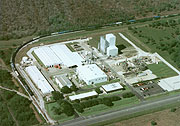
Topsoe Houston Plant |
Based on their research, it was revealed that the active ingredients of the vanadium pentoxide catalyst exists as melt within the pores of the porous silica carrier. Dr. Topsøe and Dr. Nielsen also discovered that different alkali-metal promoters such as rubidium and caesium instead of potassium increased the activity of the catalyst. Unfortunately, it wasn’t until 1988 that the first caesium-promoted catalyst was introduced by Haldor Topsøe A/S.
In 1976, Haldor Topsøe A/S introduced the first ring shaped extrudates. The ring shaped catalyst provides several advantages over the traditional cylindrical catalyst. The ring shape exposes more catalyst surface area to the process gas per catalyst volume than the cylindrical shaped. Pressure drop across the catalyst bed is also reduced due to a higher void volume for the ring shape.
Further development in catalyst shapes occurred in 1984 when Haldor Topsøe A/S introduced the daisy shaped catalyst. The daisy shape provides further enhancement of the ring shaped by creating ribs on the outside surface of the ring. Pressure drops across daisy shaped catalyst are further reduced compared to equivalent beds of ring shaped catalysts.
A major advancement in sulphuric acid catalyst occurred in 1988 with the introduction of cesium-promoted catalyst.
The physical properties of the catalyst are provided in the following table and a brief description of each catalyst is given below.
| VK38 | VK48 | VK58 | VK59 | VK69 | |
| Shapes |
6 mm pellets 10 mm rings 12 mm daisy 20 mm rings |
6 mm pellets 10 mm rings 12 mm daisy |
6 mm pellets 10 mm rings 12 mm daisy 14 mm rings |
12 mm daisy | 9 mm daisy |
| V2O5 Content | 6-8 wt% | 7-9 wt% | 6-8 wt% | - | - |
| Alkali-metal oxides | 11-15 wt% | 11-15 wt% | 20-25 wt% | - | - |
| Ignition Temperature | 360oC | 360oC | 320oC | 320oC | |
| Operating Temperature | 400-630oC | 400-550oC | 370-450oC | 370-500oC | 370-500oC |
VK38 can be used throughout the converter in all beds but is optimized for use in the first two passes. Fresh catalyst has an ignition temperature of 360oC increasing to 380oC for after years of operation. Maximum continuous operating temperature is 630oC with peaks up to 650oC for short periods of time.
VK48 has been optimized for use in the final catalyst passes. This is achieve by a higher vanadium pentoxide content combined with a change in the active phase.
VK58 is a caesium-promoted catalyst designed for use in the first pass as an ignition layer and in the final pass to enhance overall conversion. Ignition temperatures are as low as 320-330oC.
VK59 is the caesium catalyst optimised for medium to high-strength SO2 gases. This allows significant conversion improvements in single-absorption plants. The improvements to VK59 result in a catalyst with a remarkably dry surface. This formulation greatly reduces the risk of crust formation in any pass, even at elevated temperatures, and makes VK59 ideal as a top layer in first passes.
VK69 is a caesium-promoted catalyst optimized for operation in the last bed(s) of a double absorption process. The catalyst is manufactured by a special extrusion process resulting in a highly porous catalyst. The catalyst combines an increase in vanadium content with a revised composition of the active phase to achieve its enhanced performance.
| VK701 LEAP5 | |||||
| Shapes | |||||
| V2O5 Content | |||||
| Alkali-metal oxides | |||||
| Ignition Temperature | |||||
| Operating Temperature |
| VK-WSA | VK-WSX | VK-WH | VK-WL | |
| Shapes | 12 mm daisy 25 mm daisy |
9 mm daisy | 12 mm daisy | 9 mm daisy |
| V2O5 Content | 6-8 wt% | - | - | - |
| Alkali-metal oxides | 11-15 wt% | - | - | - |
| Ignition Temperature | 360oC | 340oC | 320oC | 320oC |
| Operating Temperature | 400-550oC | 370-450oC | 370-500oC | 370-450oC |
VK-WSA catalyst was developed specifically for use in Haldor Topsøe’s WSA desulphurization process. This process involves the direct oxidation of SO2 and formation of sulphuric acid in humid process gases. The catalyst possesses higher strength which is desirable in the water vapour containing process gases.