|
||
| Sulphuric Acid on the WebTM | Technical Manual | DKL Engineering, Inc. |
Knowledge for the
Sulphuric Acid Industry

Sulphuric Acid on the Web
Introduction
General
Equipment Suppliers
Contractor
Instrumentation
Industry News
Maintenance
Acid
Traders
Organizations
Fabricators
Conferences
Used
Plants
Intellectual
Propoerty
Acid
Plant Database
Market
Information
Library
Technical Manual
Introduction
General
Definitions
Instrumentation
Plant Safety
Metallurgial
Processes
Metallurgical
Sulphur Burning
Acid Regeneration
Lead Chamber
Technology
Gas Cleaning
Contact
Strong Acid
Acid Storage
Loading/Unloading
Transportation
Sulphur
Systems
Liquid SO2
Boiler Feed Water
Steam Systems
Cooling Water
Effluent Treatment
Utilities
Construction
Maintenance
Inspection
Analytical Procedures
Materials of Construction
Corrosion
Properties
Vendor Data
DKL Engineering, Inc.
Handbook of Sulphuric Acid Manufacturing
Order
Form
Preface
Contents
Feedback
Sulphuric Acid
Decolourization
Order Form
Preface
Table of Contents
Process Engineering Data Sheets - PEDS
Order
Form
Table of Contents
Introduction
Bibliography of Sulphuric Acid Technology
Order Form
Preface
Contents

Contact Section -
Catalysts
- Monsanto Enviro-Chem Systems
Janury 18, 2003
|
Introduction Catalyst Types Pellet Catalyst Type 210 Type 516 Type 11 Ring Catalyst LP-120 LP-110 LP-1150 TD-750 Cesium Promoted Catalyst Cs-120 Cs-110 Cs-210 SCX-2000 Ribbed Catalyst XLP-220 XLP-110 XCs-110 |
Associated
Links
Catalyst Unloading
|
The history of catalyst production at Monsanto dates back to the 1920's when German scientists A.O. Jaeger and J.A. Bertsch were contracted to prepare sufficient quantities of a then new vanadium catalyst for plant trials. The trials were successful and further research and development resulted in the issue of US Patent No. 1,657,754 on Januray 31, 1928 for the catalyst known at that time as the Monsanto Mass.
Today, Monsanto offers 8 different types of catalyst for various applications and situations. The most commonly specified catalysts are the LP (Low Pressure Drop) ring type catalyst. The cesium-promoted Cs type catalysts were introduced in 1989 which have higher activity and lower strike temperatures that the standard catalysts.
The physical properties of the catalyst are provided in the following tables and a brief description of each catalyst is given below.
Pellet Catalyst
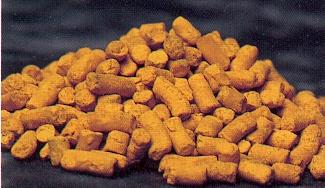
Type 210 Type 516 Type 11 I.D. (mm) - - - O.D. (mm) 5.5 8.0 5.5 Length (mm) 12 15 12 Attrition Loss (%) Ball Mill Test - - - Crush Hardness (kg) 12 16 12
This is an all purpose catalyst that provides a balance of high activity formulation and geometry. Type 210 is used in low velocity converters to aid in the distribution of gas across the bed. This catalyst exhibits high mechanical strength which minimizes losses during screening.
This catalyst is designed for use where a low pressure drop catalyst is required in the first pass but the gas velocity is too low for LP-120. Type 516 exhibits a 30% lower pressure drop than Type 210. The catalyst is designed for use in beds 1 and 2 and offers high activity and good mechanical strength
The characteristics of Type 11 are generally the same as Type 210 but with higher activity which make the catalyst ideal for the 3rd, 4th and 5th beds of a converter. The formulation is specific for high SO3 conditions and lower temperatures that are typical of beds 3, 4 and 5. The activity of Type 11 is approximately 25% higher than Type 210.
Ring Catalyst
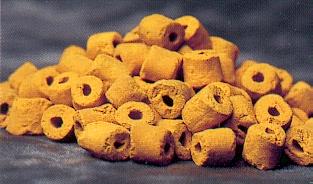
LP-120 LP-110 LP-220 LP-1150 TD-750 Shape Ring Ring Ring Ring Ring I.D. (mm) 5.0 4.0 O.D. (mm) 12.5 9.5 12.7 19.0 Length (mm) 14 13 12.7 - 14 Attrition Loss (%) Ball Mill Test 3.0 8.5 - - Crush Hardness (kg) - - - - This catalyst was first introduced by Monsanto in the late 1970's and early 1980's and was based on the original T-210 type catalyst. The old formulation in the new ring shape sufferred from higher than acceptable attrition losses so a new formulation was developed. This catalyst is primarily used in the first and second passes of a converter where low pressure drop and high activity are required. The large ring provides a high void volume permitting greater dust penetration and more uniform dust distribution. This translates to less pressure buildup over time and less frequent screenings.
LP-110 is formulated to provide high activity and is used in the lower passes of the converter where low temperatures, high SO3 and low O2 are present. The catalyst is very durable and losses during screening are low. This catalyst was introduced by Monsanto in 1981.
LP-1150 is a newly formulated catalyst specifically designed for lower bed installation to provide improved cnversin efficiency. The catalyst is approximately 10% more active than LP-120 in Bed 2 applications.
TD-750 "Top Dressing" catalyst is a large 19 mm diamter ring catalyst designed to replace the quartz rock in low linear velocity catalyst beds. The catalyst has the same formulation as LP-120 catalyst but only 50% of the activity due to the inefficiencies associated with its larger ring size.
Cesium-Promoted Catalyst
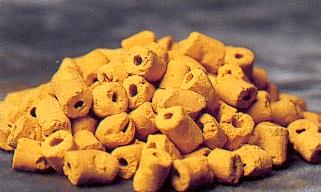
Cs-120 Cs-110 Cs-210 SCX-2000 Shape Ring Ring Pellet Ring I.D. (mm) 5.0 4.0 - O.D. (mm) 12.5 9.5 5.5 9.5 Length (mm) 14.0 13.0 12.0 9.5 - 13.0 Attrition Loss (%) Ball Mill Test 3.0 8.0 - Crush Hardness (kg) - - 12.0 This cesium-promoted catalyst is designed for upper pass applications where dust will accumulate in the bed. The large diameter ring allows for greater dust penetration which results in longer operation before the catalyst must be screened due to increases in pressure drop.
This cesium-promoted catalyst is designed for lower pass applications where temperatures are lower and the presence of SO3 inhibits the further conversion of SO2 to SO3. The catalyst is a smaller ring than Cs-120 which increases the surface area to volume ratio. This catalyst was introduced by Monsanto in 1989.
Like all pellet shape catalyst the pressure drop is higher than ring shaped catalyst. This feature make this cesium-promoted catalyst ideal for the low gas velocity converters.
SCX-2000 is a newly formulated cesium-promoted catalyst designed specifically for lower bed applications in single or double absorption plants. In addition to the new formulation, the catalyst support structure is enhanced.
XLP-220 XLP-110 XCs-110 Shape Ribbed I.D. (mm) 3.8 O.D. (mm) 11.9 Length (mm) 9.5 - 14.0