|
||
| Sulphuric Acid on the WebTM | Technical Manual | DKL Engineering, Inc. |
Knowledge for the
Sulphuric Acid Industry

Sulphuric Acid on the Web
Introduction
General
Equipment Suppliers
Contractor
Instrumentation
Industry News
Maintenance
Acid
Traders
Organizations
Fabricators
Conferences
Used
Plants
Intellectual
Propoerty
Acid
Plant Database
Market
Information
Library
Technical Manual
Introduction
General
Definitions
Instrumentation
Plant Safety
Metallurgial
Processes
Metallurgical
Sulphur Burning
Acid Regeneration
Lead Chamber
Technology
Gas Cleaning
Contact
Strong Acid
Acid Storage
Loading/Unloading
Transportation
Sulphur
Systems
Liquid SO2
Boiler Feed Water
Steam Systems
Cooling Water
Effluent Treatment
Utilities
Construction
Maintenance
Inspection
Analytical Procedures
Materials of Construction
Corrosion
Properties
Vendor Data
DKL Engineering, Inc.
Handbook of Sulphuric Acid Manufacturing
Order
Form
Preface
Contents
Feedback
Sulphuric Acid
Decolourization
Order Form
Preface
Table of Contents
Process Engineering Data Sheets - PEDS
Order
Form
Table of Contents
Introduction
Bibliography of Sulphuric Acid Technology
Order Form
Preface
Contents

Properties - Sulphur
May 31, 2005
Introduction
Moisture and Acidity
Ash and Solids
Hydrocarbons
Physical PropertiesAssociated Links
Formed Sulphur Specification
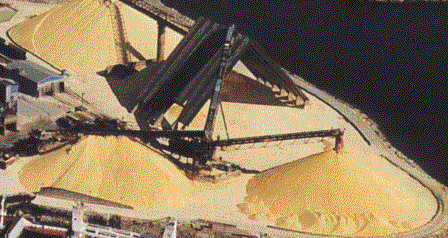
The quality of the bulk sulphur will affect whether or not pretreatment is required and the design of the sulphur handling system. Poor quality sulphur may require special handling that is not required for good quality sulphur.
The quality of sulphur can be expressed in a number of different ways. The most common classification is the one used for Frasch sulphur:
Superbright maximum organic content 0.02% C; guaranteed purity 99.5%
Bright maximum organic content 0.04% C
Dark maximum organic content 0.2% C
There are other system for classification of sulphur. 'Claus' sulphur is usually 99.98% pure and light yellow in colour. 'Lacq' quality sulphur is 99.9% pure (dry basis) and contains 0.01-0.03% organics, 0.01-0.05% ash and approximately 0.5% moisture but no arsenic, tellurium, fluorine and bitumen.
The following parameters are most frequently measured for quality control purposes.
- Moisture Content
- Ash Content
- Acidity
- Chloride Content
- Carbon Content (Organics)
- Hydrogen Sulphide Content
- Ammonia Content
- Arsenic
- Iron
The water and acidity content in the sulphur forms dilute acid, sulphuric and sulphurous, which will attack the carbon steel in storage tanks and piping and the concrete in the pits. To neutralize the dilute acid, lime is added to the sulphur.
Ash and solids may settle and accumulate in piping restricting flow and eventually block the pipe completely. Solids may also plug the sulphur gun nozzle resulting in frequent shutdowns to clear or replace the nozzle. Ash that passes through the sulphur gun will pass through the plant until it reaches the first catalyst bed. Dirt buildup in the bed increases pressure drop eventually to the point where a shutdown is required to screen the catalyst. In some older plants a Hot Gas Filter located prior to the converter serves to minimize dirt buildup in the catalyst. Alternatively, the ash and solid content in the sulphur can be reduced before the sulphur is burnt by settling or filtering. Settlers are simply large heated pits with sufficient residence time to allow the ash and solid to settle out. Filters are specially designed pressure leaf filters. The whole unit is steam jacketted to prevent solidification of the sulphur.
Hydrocarbons in the sulphur are converted to water vapour when the sulphur is burned. This moisture is carried through the plant where it will condense in the cooler parts producing acid and oleum which will corrode equipment. The problem with hydrocarbons is that they are not easily removed. Filtering and settling may remove a small portion of the hydrocarbon content. The best method of control is to use sulphur with as low a hydrocarbon content as possible.
Appearance Yellow crystalline solid or liquid Crystalline Forms Rhombic and Monoclinic Melting Point 110 to 121°C depending on crystalline form Boiling Point 444.6°C Auto-ignition Temperature Dust: 190°C
Dust Layers: 221°C
Liquid: 248 to 261°CFlash Point 168 to 188°C Vapour Pressure < 0.1 mm Hg @ 20°C Explosive Limits of Dust in Air LEL: 35 g/m3
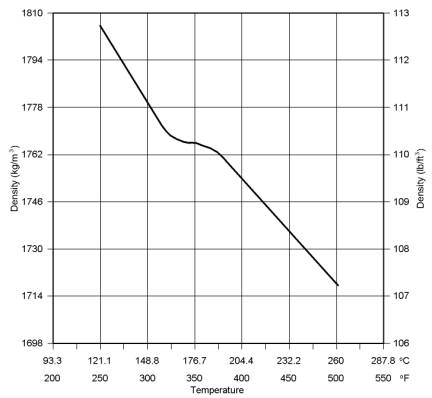
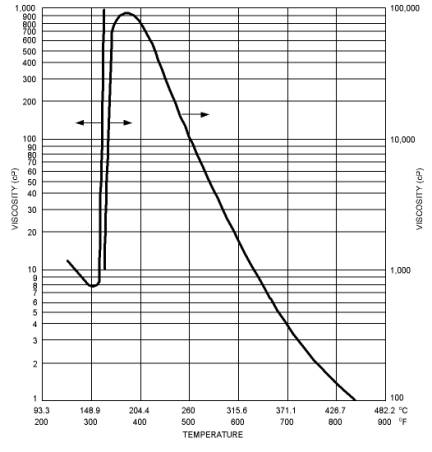
UEL: 1400 g/m3Specific Gravity 1.92 to 2.07 depending on crystalline form Liquid Sulphur Density 1786.5 kg/m3 @ 140°C (See Graph) Surface Tension 60.83 mN/m @ 120°C Viscosity See Graph Bulk Sulphur Angle of Repose 35° (approximate) Bulk Density 770 kg/m3 (48 lb/ft3) Density
Viscosity