|
||
| Sulphuric Acid on the WebTM | Technical Manual | DKL Engineering, Inc. |
Knowledge for the
Sulphuric Acid Industry

Sulphuric Acid on the Web
Introduction
General
Equipment Suppliers
Contractor
Instrumentation
Industry News
Maintenance
Acid
Traders
Organizations
Fabricators
Conferences
Used
Plants
Intellectual
Propoerty
Acid
Plant Database
Market
Information
Library
Technical Manual
Introduction
General
Definitions
Instrumentation
Plant Safety
Metallurgial
Processes
Metallurgical
Sulphur Burning
Acid Regeneration
Lead Chamber
Technology
Gas Cleaning
Contact
Strong Acid
Acid Storage
Loading/Unloading
Transportation
Sulphur
Systems
Liquid SO2
Boiler Feed Water
Steam Systems
Cooling Water
Effluent Treatment
Utilities
Construction
Maintenance
Inspection
Analytical Procedures
Materials of Construction
Corrosion
Properties
Vendor Data
DKL Engineering, Inc.
Handbook of Sulphuric Acid Manufacturing
Order
Form
Preface
Contents
Feedback
Sulphuric Acid
Decolourization
Order Form
Preface
Table of Contents
Process Engineering Data Sheets - PEDS
Order
Form
Table of Contents
Introduction
Bibliography of Sulphuric Acid Technology
Order Form
Preface
Contents

Sulphur Burning -
Sulphur Burners
May 14, 2002
|
Introduction Sulphur Guns Rotary Cup Burners |
Associated
Links Sulphur Furnace |
There are basically two types of sulphur burners in use in sulphur burning acid
plants; Sulphur Guns using an atomizing spray nozzle and Rotary Cup Burners.
Two fluid atomizing nozzles are not commonly used.
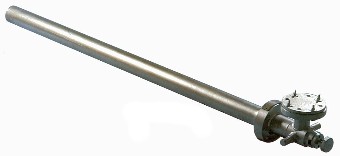
A sulphur gun consists of a steam jacketed pipe with a atomizing spray nozzle
mounted on the end. The steam
jacketed pipe is long enough to place the spray nozzle at the front on the
furnace an serves to keep the gun cool and maintain the sulphur in the molten
state.
 Early
sulphur guns used a standard ‘Spraco’ type nozzle screwed onto the end of the
sulphur gun. More
sophisticated design are now available but the all work on the same principal.
Early
sulphur guns used a standard ‘Spraco’ type nozzle screwed onto the end of the
sulphur gun. More
sophisticated design are now available but the all work on the same principal.
An atomizing spray nozzle is a device which breaks up a mass of liquid into a
multitude of droplets, serving the general purpose of increasing the surface
area. Spray nozzles create droplets
by using the energy in a pressurized liquid to break up the liquid stream into
droplets as the liquid passes through an orifice.
In this case, the formation of droplets and the increase in surface area allows
for the efficient and thorough combustion of sulphur in the sulphur furnace.
Spray nozzles require a high pressure drop to effectively atomize the molten
sulphur. Pump delivery pressures
for molten sulphur are typically 690 kPag (100 psig) or higher.
Spray nozzles with fixed orifice sizes are limited in their turndown ability.
Typically the flow of molten sulphur is controlled by an upstream control valve.
As the valve is closed a greater portion of the pressure drop is taken across
the valve reducing the pressure at the spray nozzle.
The effectiveness of the spray nozzle is greatly reduced as the inlet pressure
is reduced. To overcome this problem the orifice in the spray nozzle must
be changed to a smaller size. This
requires a stoppage in the plant in order to change the spray nozzle.
This problem is partially overcome by having multiple sulphur guns installed in
the furnace. As plant production is
reduced, sulphur guns are taken out of service so pressure at the spray nozzle
is not significantly reduced. For
small plants, multiple sulphur guns are not as practical or necessary as in
larger plants.
Some sulphur gun designs have been developed where the control of sulphur flow
is done right at the spray nozzle.
This eliminates the turndown problem of fixed orifice spray nozzles. A control rod runs down the length of the sulphur gun and
extends through the spray nozzle orifice creating an annular space for sulphur
flow. To increase sulphur flow, the
control rod is extracted increasing the size of the annular space (i.e. orifice
area). The advantage is that high
pressures are maintained right at the inlet of the spray nozzle providing for
good atomization at all flow rates.
One disadvantage is that as the size of the orifice is reduced, the nozzle is
more prone to blockage.
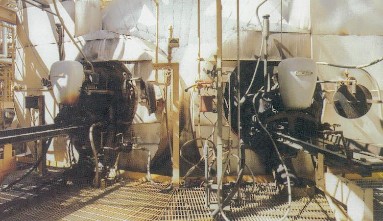
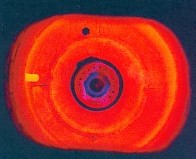
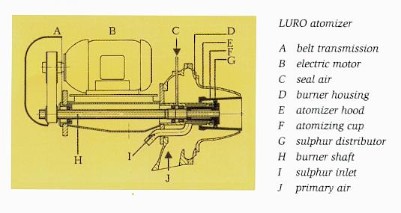
A rotary cup burner consists of a spinning cup spinning at high speed which atomizes the molten sulphur. The spinning cup is driven by an electric motor through a drive belt system. Sulphur is fed to the burner at a low pressure (< 1 bar g) compared to a pressurized spray nozzle. The high speed rotating cup ensures that the sulphur is atomized to a high degree. The result is a short intense flame that provides for complete combustion of the sulphur to sulphur dioxide. The burner permits a high specific furnace load (2 Gcal/m³) compared to the pressurized spray nozzle (0.75 Gcal/m³).
Since the burner does not rely on a high pressure drop, burner turndown ratios of 1:5 are possible the need to change any spray nozzles. The capacity of the burner is controlled by a control valve on the molten sulphur line. Typical burner capacities range from 5 to 600 tpd of sulphur.
The burner can also be used to burn fuel oil during the preheating step and can be quickly switched over to sulphur when required.