|
||
| Sulphuric Acid on the WebTM | Technical Manual | DKL Engineering, Inc. |
Knowledge for the
Sulphuric Acid Industry

Sulphuric Acid on the Web
Introduction
General
Equipment Suppliers
Contractor
Instrumentation
Industry News
Maintenance
Acid
Traders
Organizations
Fabricators
Conferences
Used
Plants
Intellectual
Propoerty
Acid
Plant Database
Market
Information
Library
Technical Manual
Introduction
General
Definitions
Instrumentation
Plant Safety
Metallurgial
Processes
Metallurgical
Sulphur Burning
Acid Regeneration
Lead Chamber
Technology
Gas Cleaning
Contact
Strong Acid
Acid Storage
Loading/Unloading
Transportation
Sulphur
Systems
Liquid SO2
Boiler Feed Water
Steam Systems
Cooling Water
Effluent Treatment
Utilities
Construction
Maintenance
Inspection
Analytical Procedures
Materials of Construction
Corrosion
Properties
Vendor Data
DKL Engineering, Inc.
Handbook of Sulphuric Acid Manufacturing
Order
Form
Preface
Contents
Feedback
Sulphuric Acid
Decolourization
Order Form
Preface
Table of Contents
Process Engineering Data Sheets - PEDS
Order
Form
Table of Contents
Introduction
Bibliography of Sulphuric Acid Technology
Order Form
Preface
Contents

Storage/Loading/Unloading - Tank Car
April
2, 2008
|
Introduction New Regulations Integrity of Top Fittings Pressure Relief Valves |
Associated
Links
Loading Procedure |
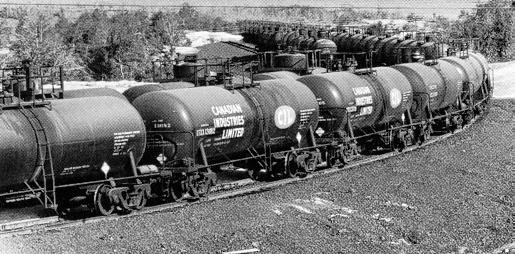
The transportation of sulphuric acid over large distances is a requirement since the acid is rarely produced in the vicinity of its use. One of the most effective means of moving large quantities of acid overland is using rail tank cars. The most economical way to transport acid by rail is the use of unit trains. Unit trains are dedicate trains consisting of 36 to 56 tank cars (3600 to 5600 tons) that move acid from the production site to storage depots located in the heart of the market areas. From the storage depots acid can be further distributed by rail tank car or by tank trucks
Two sizes of tank cars are in general use; 50 and 100 ton tank cars.
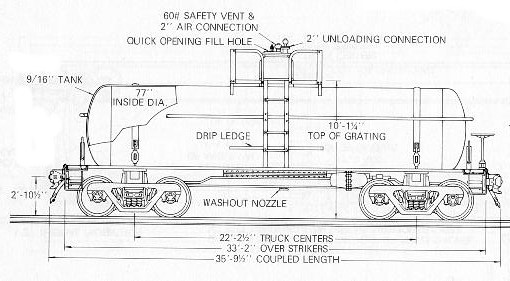
7,000 US Gallon Capacity - DOT 103AW (50 ton)
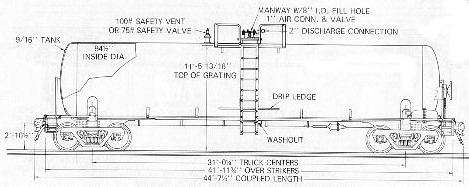
13,350 US Gallon Capacity - DOT 111A100W2 (100 ton)
Tank cars carrying sulphuric acid generally are equipped with the following:
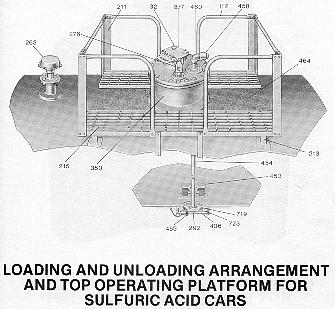
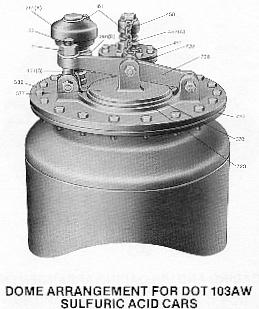
The Association of American Railroads (AAR) has adopted a requirement that new and existing sulphuric acid cars be equipped to provide improved top fittings integrity. This is an effort to enhance the durability of top fittings if cars roll over in an accident. In a typical derailment, product is loss when top fittings become damaged.
Improved integrity of the top fittings can be provided in a number of ways. One option is to lower the profile of the top fittings so they are better protected. Structural protective devices can be used in combination with the lower profile. AAR document CPC-1117 details these requirements.
Regulations require that the retrofits to existing tank cars be completed in ten (10) years.
The AAR has adopted a requirement that 35 psi pressure relief valves be removed from tanks in hazardous materials service. These pressure relief valves have been the cause of non-accidental releases of materials which have been implicated in injuries to railway personnel. AAR document CPC-1119 provides details. The 35 psi pressure relief valve is to be replaced with a new pressure relief valve set at 75 psi.