|
||
| Sulphuric Acid on the WebTM | Technical Manual | DKL Engineering, Inc. |
Knowledge for the
Sulphuric Acid Industry

Sulphuric Acid on the Web
Introduction
General
Equipment Suppliers
Contractor
Instrumentation
Industry News
Maintenance
Acid
Traders
Organizations
Fabricators
Conferences
Used
Plants
Intellectual
Propoerty
Acid
Plant Database
Market
Information
Library
Technical Manual
Introduction
General
Definitions
Instrumentation
Plant Safety
Metallurgial
Processes
Metallurgical
Sulphur Burning
Acid Regeneration
Lead Chamber
Technology
Gas Cleaning
Contact
Strong Acid
Acid Storage
Loading/Unloading
Transportation
Sulphur
Systems
Liquid SO2
Boiler Feed Water
Steam Systems
Cooling Water
Effluent Treatment
Utilities
Construction
Maintenance
Inspection
Analytical Procedures
Materials of Construction
Corrosion
Properties
Vendor Data
DKL Engineering, Inc.
Handbook of Sulphuric Acid Manufacturing
Order
Form
Preface
Contents
Feedback
Sulphuric Acid
Decolourization
Order Form
Preface
Table of Contents
Process Engineering Data Sheets - PEDS
Order
Form
Table of Contents
Introduction
Bibliography of Sulphuric Acid Technology
Order Form
Preface
Contents


Storage/Loading/Unloading -
Storage Tanks - Foundations
April
2, 2008
|
Foundations Reinforced Concrete Slab Foundations Steel I-Beams and Concrete Supports Concrete Ring Wall Foundation |
Associated Links |
It is essential to design and construct a proper foundation for sulphuric acid storage tanks. Not only must the foundation adequately support the weight of a fully loaded tank, it must be designed to keep the bottom of the tank dry. A wet foundation can lead to external corrosion in the form of general metal loss or more localized pitting corrosion. Detection of pitting corrosion is extremely difficult especially in a large tank since the entire bottom must be scanned ultrasonically. Pitting corrosion is usually discovered when a leak occurs.
Accumulation of wet dirt or debris at a shell-to-bottom joint will result in general corrosion of the metal. This can easily be prevented by keeping the area clean and dry. However, if the tank is not sitting on a proper foundation is may be settling or in constant contact with the wet soil.
These problems underline the importance of proper foundation design and construction. There are generally 3 types of foundations commonly in use:
- Reinforced concrete slab foundation
- Steel I- Beams and concrete supports
- Concrete ring wall foundation
Reinforced Concrete Slab Foundation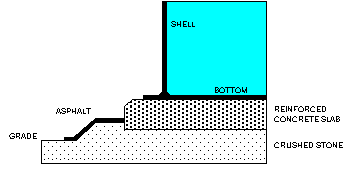
This type of foundation is generally suitable for tanks under 12 m (39’) diameter. The bottom of the tank rest completely on a raised reinforced concrete slab. The ground around the tank is sloped away from the foundation and an asphalt covering ensures that water will run away from the foundation.
Steel I-Beams and Concrete Supports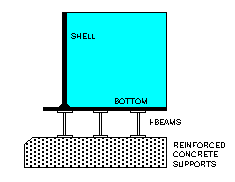
This type of foundation is generally suitable for tanks under 12 m (39’) diameter. The bottom of the tank rests on steel I-beams that sit on concrete supports. The space under the tank and between the I-beams is left open so leaks in the bottom of the tank can be easily detected.
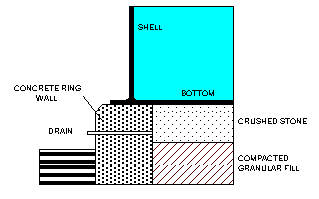
This type of foundation is generally suitable for tanks over 12 m (39’) diameter. The edge of the tank sits on the concrete ring wall which carries the weight of the tan shell. The space inside the foundation and under the tank is filled with compacted granular fill that is topped with crushed stone graded to a maximum size of 19 mm (3/4”). Limestone is never used as the fill material. Drains should be provided in the ring wall so that any acid leaks will drain out and be detected.