|
||
| Sulphuric Acid on the WebTM | Technical Manual | DKL Engineering, Inc. |
Knowledge for the
Sulphuric Acid Industry

Sulphuric Acid on the Web
Introduction
General
Equipment Suppliers
Contractor
Instrumentation
Industry News
Maintenance
Acid
Traders
Organizations
Fabricators
Conferences
Used
Plants
Intellectual
Propoerty
Acid
Plant Database
Market
Information
Library
Technical Manual
Introduction
General
Definitions
Instrumentation
Plant Safety
Metallurgial
Processes
Metallurgical
Sulphur Burning
Acid Regeneration
Lead Chamber
Technology
Gas Cleaning
Contact
Strong Acid
Acid Storage
Loading/Unloading
Transportation
Sulphur
Systems
Liquid SO2
Boiler Feed Water
Steam Systems
Cooling Water
Effluent Treatment
Utilities
Construction
Maintenance
Inspection
Analytical Procedures
Materials of Construction
Corrosion
Properties
Vendor Data
DKL Engineering, Inc.
Handbook of Sulphuric Acid Manufacturing
Order
Form
Preface
Contents
Feedback
Sulphuric Acid
Decolourization
Order Form
Preface
Table of Contents
Process Engineering Data Sheets - PEDS
Order
Form
Table of Contents
Introduction
Bibliography of Sulphuric Acid Technology
Order Form
Preface
Contents

Materials of Construction -
Metals - 316/316L SS
May 28, 2003
|
Introduction Chemical Composition Corrosion Resistance Designations Specifications Physical Properties Mechanical Properties Fabrication |
Associated Links |
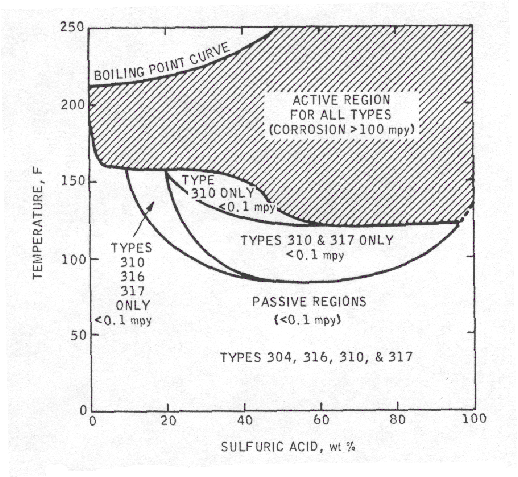
Type 316/316L stainless steel is a molybdenum beraing grade of steel. The presence of molybdenum gves this stainless steel better overall corrosion resistance properties than types 301 and 304 stainless steel. Type 316 gives useful service at room temperature in sulphuric acid of concentrations lower than 15% wt. and greater than 85% wt. It also resist chloride attack and is often used in marine environments.
Type 316L has a maximum carbon content of 0.03% wt. It is used in applications where it is not possible to anneal after welding and where maximum corrosion resistance is required.
Chemical Composition (wt% typical)
| 316 | 316L | ||
| Nickel | Ni | 10.0 - 14.0 | 10.0 - 14.0 |
| Chromium | Cr | 16.0 - 18.0 | 16.0 - 18.0 |
| Manganese | Mn | 2.0 max | 2.0 max |
| Iron | Fe | Balance | Balance |
| Carbon | C | 0.08 max | 0.03 max |
| Phosphorus | P | 0.045 max | 0.045 max |
| Sulphur | S | 0.030 max | 0.030 max |
| Silicon | Si | 1.0 max | 1.0 max |
| Molybdenum | Mo | 2.0 to 3.0 | 2.0 to 3.0 |
UNS S3_____
| ASTM | Tube and Pipe | |
| Pipe - Welded | ||
| Pipe - Seamless | ||
| Tube - Welded | ||
| Tube - Seamless | ||
| Bars and Shapes | ||
| Forgings | ||
| Forged Flanges and Fittings | ||
| Plate and Sheet | ||
| Strip | ||
| Rod and Shapes |
| Electrical Resistivity | 68°F | 74 microhm-cm |
| Coefficient of Thermal Expansion | 0-100°C (32-212°F) | 8.9 E-6 in/in °F |
| Magnetic Permeability |
1.02 | |
| Themal Conductivity | 100°C
(212°F) 500°C (932°F) |
9.4 BTU/ft h °F 12.4 BTU/ft h °F |
| Ultimate Tensile Strength | 579 MPa (84,000 psi) |
| Elongation in 50.8 mm (2 in.) | 50% |
| Yield Strength (0.2% offset) | 290 MPa (42,000 psi) |
| Hardness | 80 Rb 149 BHN |
| Impact Charpy | 135 ft lbs |
| Modulus of Elasticity (Tension) | 193,052 MPa (28,000,000 psi) |
Welding
Good characteristics suited to all standard methods. Use Type 316Cb, 316L or 309Cb filler rods or electrodes depending on application. Welded sections in Type 316 require post-weld annealing for maximum corrosion resistance. This is not required if Type 316L is used.
Heat Treatment
Heat to 1010°C to 1121°C (1850°F to 2050°F) and cool rapidly. Type 316 and 316L cannot be hardended by thermal treatment.

