|
||
| Sulphuric Acid on the WebTM | Technical Manual | DKL Engineering, Inc. |
Knowledge for the
Sulphuric Acid Industry

Sulphuric Acid on the Web
Introduction
General
Equipment Suppliers
Contractor
Instrumentation
Industry News
Maintenance
Acid
Traders
Organizations
Fabricators
Conferences
Used
Plants
Intellectual
Propoerty
Acid
Plant Database
Market
Information
Library
Technical Manual
Introduction
General
Definitions
Instrumentation
Plant Safety
Metallurgial
Processes
Metallurgical
Sulphur Burning
Acid Regeneration
Lead Chamber
Technology
Gas Cleaning
Contact
Strong Acid
Acid Storage
Loading/Unloading
Transportation
Sulphur
Systems
Liquid SO2
Boiler Feed Water
Steam Systems
Cooling Water
Effluent Treatment
Utilities
Construction
Maintenance
Inspection
Analytical Procedures
Materials of Construction
Corrosion
Properties
Vendor Data
DKL Engineering, Inc.
Handbook of Sulphuric Acid Manufacturing
Order
Form
Preface
Contents
Feedback
Sulphuric Acid
Decolourization
Order Form
Preface
Table of Contents
Process Engineering Data Sheets - PEDS
Order
Form
Table of Contents
Introduction
Bibliography of Sulphuric Acid Technology
Order Form
Preface
Contents


Materials of Construction -
Acid Resistant Linings - Installation Details
May 9, 2003
|
Introduction Corbel or Ledge Nozzles Floor and Wall Transitions Dome Packing Support Bottom |
Associated Links |
The proper specification and installation of an acid resistant lining is important to ensure that the lining will provide trouble free service for the life of the equipment. The following details are typical of good acid brick installations.
|
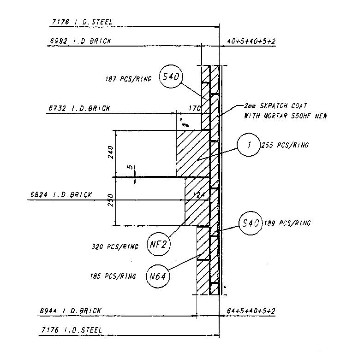
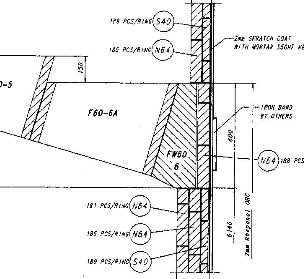
Corbel or Ledge A corbel or ledge is often used to support beams of a packing support system or distributor. Progressively wider bricks are used to create a ledge of the desired width. The design of the ledge will depend on the load that it must carry and the required width. A poorly designed ledge may crack or pull away from the vessel wall under the load resulting in a leak path to the shell and eventual corrosion of the metal shell. |
|
|
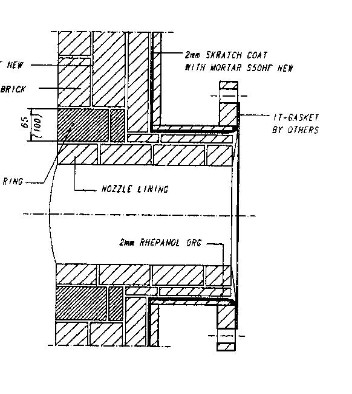
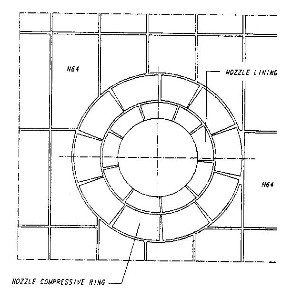
Nozzles All vessels require nozzles to transfer liquid/gas into and out of the vessel, however, any break in the shell lining is a potential weak point where a leak through the lining may occur. The design and installation of a nozzle lining is important in order to prevent potential leaks in the lining. Large nozzles can be lined using specially shaped bricks sized for the inside diameter of the nozzle. The number of layers required will depend on the service conditions. Smaller nozzles can be lined with specially produced cylindrical liners or sleeves. These are generally available as small as 50 mm O.D. and 20 mm I.D. to as large as 190 mm O.D. and 130 mm I.D. |
|
|
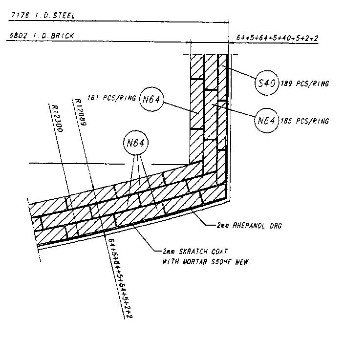
Floor and Wall Transition Any change or transition in the lining is a potential weak point in the lining. Such a transition occurs where the vertical shell meets the dished bottom of the vessel. To ensure the integrity of the lining multiple layers of brick are typically used. The layers are also staggered to create a step pattern at the corner so there will not be a direct leak path to the shell through a mortar joint. |
|
|
Dome Packing Support Dome packing supports require special attention at the wall of the vessel in order to transfer the load of the packing into the shell and down through the shell lining. The last ring of the dome support is always custom made to suit the inside diameter of the vessel. A specially shaped brick is used at the wall to exactly match the angle of the dome's outer ring. The load is thus transferred to the lining on the shell. The brick lining below the dome is generally thicker than above the dome since the lining below the dome must carry the weight of the packing and dome. The load on the dome also exerts an outward force on the metal shell. A metal reinforcing ring or thicker shell is always required at the point where the dome meets the shell in order to strengthen the shell. |
|
|
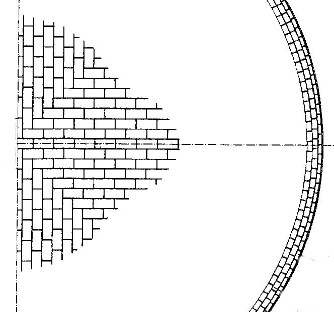
Bottom The bottom of a vertical vessel should always be dished so that the lining is always in compression. This will prevent the floor from heaving due to the formation of iron sulphate between the shell and the lining. The recommended pattern for laying the floor is shown opposite. This pattern ensure the forces in the floor lining are evenly spread and uniform. Successive layers should be laid in a different orientation to ensure the mortar joints are staggered.
|
|
|
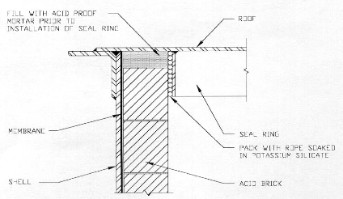
Pump Tank Roof Special attention must be paid to the region where the brick lining meets a metal roof such as in a vertical cylindrical pump tank. The top of the brick lining must be sealed in order to prevent acid from getting in behind the lining. This is done by filling the gap from the top of the brick lining to the under side of the roof with mortar. A drip ring is installed to ensure that acid running along the roof is directed down the face of the brick. To prevent liquid from entering the gap between the drip ring and the face of the brick, the gap is packed with rope soaked in potassium silicate. |
|