|
||
| Sulphuric Acid on the WebTM | Technical Manual | DKL Engineering, Inc. |
Knowledge for the
Sulphuric Acid Industry

Sulphuric Acid on the Web
Introduction
General
Equipment Suppliers
Contractor
Instrumentation
Industry News
Maintenance
Acid
Traders
Organizations
Fabricators
Conferences
Used
Plants
Intellectual
Propoerty
Acid
Plant Database
Market
Information
Library
Technical Manual
Introduction
General
Definitions
Instrumentation
Plant Safety
Metallurgial
Processes
Metallurgical
Sulphur Burning
Acid Regeneration
Lead Chamber
Technology
Gas Cleaning
Contact
Strong Acid
Acid Storage
Loading/Unloading
Transportation
Sulphur
Systems
Liquid SO2
Boiler Feed Water
Steam Systems
Cooling Water
Effluent Treatment
Utilities
Construction
Maintenance
Inspection
Analytical Procedures
Materials of Construction
Corrosion
Properties
Vendor Data
DKL Engineering, Inc.
Handbook of Sulphuric Acid Manufacturing
Order
Form
Preface
Contents
Feedback
Sulphuric Acid
Decolourization
Order Form
Preface
Table of Contents
Process Engineering Data Sheets - PEDS
Order
Form
Table of Contents
Introduction
Bibliography of Sulphuric Acid Technology
Order Form
Preface
Contents


Materials of Construction -
Insulation - Inspection and Maintenance
June 1, 2003
|
Introduction Inspection During Operation |
Associated Links |
Insulation is often overlooked in terms of inspection and maintenance of a plant. During equipment inspection and maintenance, insulation is often removed to permit access to manways, valves, instruments, etc. However, when the work is done the insulation is not always reinstalled to a like new condition. The insulation and cladding may be completely left off or even worse, installed incorrectly. Poorly installed insulation and cladding will give the impression that it is performing its function but in reality is only hiding a more serious problem that can lead to future damage to the equipment.
Poorly installed insulation will result in cold spots on the equipment which may lead to uneven mechanical stresses, condensation and corrosion. In the case of molten sulphur, the result of poor insulation may be troublesome freezing of sulphur in lines. Loose cladding or improper weather proofing may result in the ingress of moisture. Wet insulation has a much lower insulating value which can lead to some of the problems previously noted.
During construction the installation of insulation and clading must be monitored closely to ensure it will perform properly in service. Insulation standards and details must be provided to the insulation contractor to ensure the installation meets the minimum requirements. As an alternative, the insulation contractor should provide a set of standard details for review and approval. Materials should be inspected to ensure they meet the requirements of the specification.
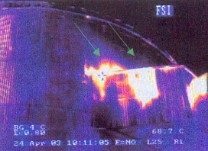
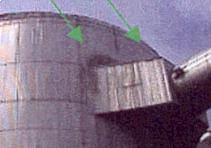
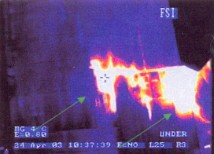
The easiest and simplest method for inspecting insulation during plant operation is by thermal imaging. Infrared pictures are taken of the equipment to reveal hot spots on the surface of equipment and insulation. Some examples of thermal images are provided below.
 |
 |
 |
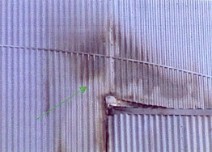 |
The thermal image is shown on the right with the corresponding actual image on the right. The white areas on the thermal image indicate 'hot spots' on the surface of the insulation indicating some deficiency in the underlying insulation. Over time, the hot spots may discolour the cladding giving further evidence of the underlying problems.

