|
||
| Sulphuric Acid on the WebTM | Technical Manual | DKL Engineering, Inc. |
Knowledge for the
Sulphuric Acid Industry

Sulphuric Acid on the Web
Introduction
General
Equipment Suppliers
Contractor
Instrumentation
Industry News
Maintenance
Acid
Traders
Organizations
Fabricators
Conferences
Used
Plants
Intellectual
Propoerty
Acid
Plant Database
Market
Information
Library
Technical Manual
Introduction
General
Definitions
Instrumentation
Plant Safety
Metallurgial
Processes
Metallurgical
Sulphur Burning
Acid Regeneration
Lead Chamber
Technology
Gas Cleaning
Contact
Strong Acid
Acid Storage
Loading/Unloading
Transportation
Sulphur
Systems
Liquid SO2
Boiler Feed Water
Steam Systems
Cooling Water
Effluent Treatment
Utilities
Construction
Maintenance
Inspection
Analytical Procedures
Materials of Construction
Corrosion
Properties
Vendor Data
DKL Engineering, Inc.
Handbook of Sulphuric Acid Manufacturing
Order
Form
Preface
Contents
Feedback
Sulphuric Acid
Decolourization
Order Form
Preface
Table of Contents
Process Engineering Data Sheets - PEDS
Order
Form
Table of Contents
Introduction
Bibliography of Sulphuric Acid Technology
Order Form
Preface
Contents


Instrumentation - Acid Concentration
March 25, 2024
|
Introduction Conductivity Refraction Sound Velocity Recommended Methods Instruments |
Associated Links |
The on-line continuous measurement of sulphuric acid/oleum is based on the fact that a physical property will change as the concentration changes. Properties such as conductivity, refractive index and sound velocity are typically used to measure sulphuric acid/oleum concentrations. The recommended methods of measurement over the whole range of sulphuric acid and oleum are given below.
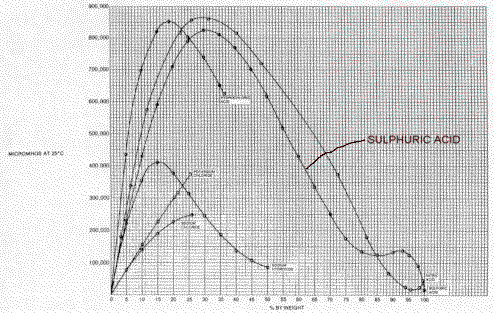
Electrical conductivity is a property of a fluid that can be used to determine
its concentration. The graph below shows the conductivity (micromhos) at
25ºC for several different fluids, including sulphuric acid from 0 to 100%wt.
The vertical axis ranges from 0 to 900,000 micromhos.
For sulphuric acid, the conductivity varies such that for a given conductivity
there could be more than one concentration. This makes conductivity
unsuitable for measurement over the full range of acid concentration (i.e.
0 to 100% H2SO4).
However, conductivity can be used where the concentration will vary over a small
range and where the range will not cross over one of the peaks or valleys of the
conductivity curve.
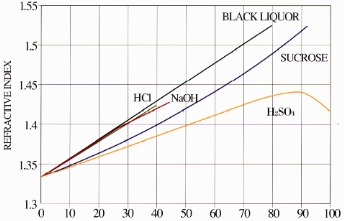
The refraction of light through sulphuric acid will depend on the temperature and concentration. This property can be used to determine the concentration of sulphuric acid.
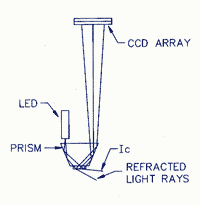
Energy radiated from a LED passes through the prism surface to be reflected off a mirror to the prism-to-process interface. The light reaching this interface intersects the same interface over a series of angles chosen to include the critical angle (Ic) for the process being measured. Light intersecting the interface at an angle greater than the critical angle is refracted into the solution. Light intersecting the interface at less than the critical angle is reflected up to a mirror and out of the prism up to the charge coupled device (COD) linear array to be scanned.
The image seen by the CCD is composed of simple light and dark periods. As the refractive index of the process changes, the change in critical angle, changes the ratio of light to dark periods as seen by the CCD. This time period change is further enhanced and displayed as a reading in refractive index.
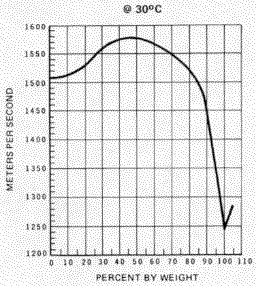
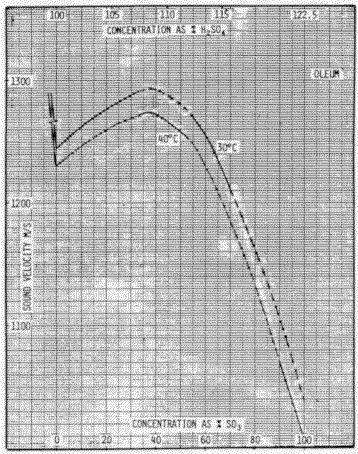
The velocity of sound in sulphuric acid/oleum can be used to determine the acid
concentration. The first graph illustrates the variation of sound velocity
with acid concentration (0 to 100% H2SO4)
and second graph illustrates the same relationship except for oleum.
The nature of sound velocity in sulphuric acid makes this property ideal for
determining acid concentrations in the range of 60 to 100% H2SO4.
Calibration of the instrument is done by comparison with acid of known
concentration.
The velocity of sound in sulphuric acid/oleum is affected by the presence of bubbles and cleanliness of the acid. The sample must be drawn off in such a manner as to avoid entrainment of bubbles and foreign matter which will affect the accuracy of the measurement.
The recommended methods of measurement over the whole range of sulphuric acid and oleum are given in the following table.
| Sulphuric
Acid %H2SO4 |
Oleum % Oleum |
Recommended Method |
| 0-25% | - | Conductivity |
| 35-75% | - | Conductivity |
| 60-100% | - | Sound Velocity |
| 95-100% | - | Conductivity, Sound
Velocity |
| 100-107.875% | 0-35% | Sound Velocity |
| 107.875-122.5% | 35-100% | Sound Velocity |
| Type | Range | Manufacturer | Model No. | Remarks |
| Conductivity and Sound Velocity | - | SensoTech GmbH | LiquiSonic | Accuracy: ± 0.05 wt% Brochure |
| Conductivity |
0-25% H2SO4 35-75% 95-100% H2SO4 |
Foxboro |
Trans:
870EC-TF49F Sensor: 871EC-TF2-V Mtg Flg: 51191/EP129A (2") |
Temperature compensation required |
| Rosemount | Model 222 Toroidal Conductivity |
Maximum
Temperature: 182ºC Maximum Pressure: 125 psig Connection: 1" or 2" - 150 lb Flange Temperature compensation required |
||
| Density | 0-90% H2SO4 |
 |
DMA 5001 | Benchtop density
meter Accuracy: <0.01% w/w Can be combined with automatic filling device (Xsample 320) Link to Anton Paar |
| DMA 35 Ampere | Handheld device for
onsite measurement Accuracy: 0.5% w/w Link to Anton Paar |
|||
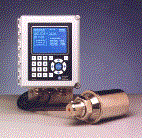
| Refraction | - | The Electron-Machine Corp. |
MPR E-Scan
|
Accuracy: ± 1% of span or 0.000075 Refractive Index (RI) whichever is
greater |
| - |
 |
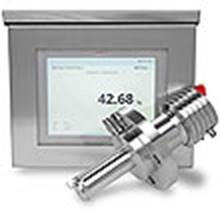
PIOX R721 |
Range: nD: 1.3 ... 1.7,
oBrix: 0
... 100 Temperature: -20 to 130oC Pressure: PN10, PN16, on request PN40 |
|
| - |
 |
Products:
Probe
Process Refractometer PR-43-GP Compact Process Refractometer PR-43-GP, Saunders Body Refractometer PR-23-W Teflon Body Refractometer PR-23-M,
Refinery Probe
Process Refractometer PR-23-RP.
|
Range:
Measurement range
covers
0-100 % by weight (Refractive Index nD 1.3200 – 1.5300).
Remarks:
Reliable and accurate product based on digital
sensing technology;
even large amounts of suspended solids, bubbles or color changes do not affect the
measurement or the accuracy. The accuracy is ±0.1 % b.w. and the measurement
is automatically temperature compensated. The technology allows
configuring low and high concentration alarms.
Intrinsically safe and hazardous area certification is provided for
hazardous areas.
Special wetted
parts materials such as AISI 904L stainless steel, Alloy 20, Hastelloy
C-276, Nickel 200 and Titanium ASTM B348.
Process
temperature range: -20°C
to 150°C /
-4°F
to 302°F.
|
|
| Sound Velocity | 60-100% H2SO4 |
Nusonics |
Model 86 Sonic
Concentration Monitor Sensor: HSX/T |
Accuracy: ±
0.1wt% for 90-100% Range: 500-3000 m/s Temperature: -15 to 185ºC Application Note |
| Sound Velocity and Density |
0-100% H2SO4 0-65% free SO3 |
|
DSA 5000 |
Benchtop sound velocity and density meter Accuracy: 0.02% w/w H2SO4, 0.04-0.1% free SO3 Covers the whole sulfuric acid (0-100%) and Oleum range (0-65%) Can be combined with automatic filling device (Xsample 320) Link to Anton Paar |
| 0-110% H2SO4 |
|
L-Sonic 5100 L-Dens 7400 L-Com 5500 |
|