|
||
| Sulphuric Acid on the WebTM | Technical Manual | DKL Engineering, Inc. |
Knowledge for the
Sulphuric Acid Industry

Sulphuric Acid on the Web
Introduction
General
Equipment Suppliers
Contractor
Instrumentation
Industry News
Maintenance
Acid
Traders
Organizations
Fabricators
Conferences
Used
Plants
Intellectual
Propoerty
Acid
Plant Database
Market
Information
Library
Technical Manual
Introduction
General
Definitions
Instrumentation
Plant Safety
Metallurgial
Processes
Metallurgical
Sulphur Burning
Acid Regeneration
Lead Chamber
Technology
Gas Cleaning
Contact
Strong Acid
Acid Storage
Loading/Unloading
Transportation
Sulphur
Systems
Liquid SO2
Boiler Feed Water
Steam Systems
Cooling Water
Effluent Treatment
Utilities
Construction
Maintenance
Inspection
Analytical Procedures
Materials of Construction
Corrosion
Properties
Vendor Data
DKL Engineering, Inc.
Handbook of Sulphuric Acid Manufacturing
Order
Form
Preface
Contents
Feedback
Sulphuric Acid
Decolourization
Order Form
Preface
Table of Contents
Process Engineering Data Sheets - PEDS
Order
Form
Table of Contents
Introduction
Bibliography of Sulphuric Acid Technology
Order Form
Preface
Contents

Gas Cleaning System -
Electrostatic Precipitators - Erection
November
29, 2008

| Introduction | Associated
Links
Operation |
Fabrication of Lead Tubes
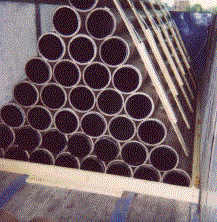
Lead precipitator tubes are fabricated in one of two ways. The mechanical properties of lead allow the tubes to be extruded with the proper equipment. Extruded tubes are more common in North America where the dies and presses are available for the production of 254 mm (10") diameter tubes. Extruded tubes are manufactured in the factory and must be shipped to site. To prevent damage to the tubes during handling and shipment the lead tubes are inserted into thick cardboard tubes similar to the formwork tubes used for concrete columns (see photo below).
The alternate method of fabricating the tubes is from sheet material. A 'former' table is used which has a semi-circular slot which has the same radius as the lead tube outside diameter. A pre-cut sheet of lead is pressed into the slot to form half of the tube using a core or mandrel having a diameter equal to the tube inside diameter. The remainder of the lead sheet is wrapped around the mandrel leaving a longitudinal seam which is then lead burned to complete the tube. The lead tube complete with mandrel is lifted by crane and inserted through the tubesheet of the precipitator. The top of the tube is folded out to form a flange which supports the tube in the tube sheet. The mandrel has a cam/screw mechanism which reduces the diameter of the mandrel allowing it to be withdrawn from the tube. The mandrel is lowered back down and is ready to be used to form the next tube. The lead tube is then aligned and lead burned into the tube sheet. Any runs or beads are removed from the inside of the tube by scraping. The bottom of the tube is then belled outwards to complete the installation of the tube.
Erection Sequence
The following description and pictures gives a brief outline of the fabrication and erection of a FRP/lead WESP.
|
Lead tubes are being prepared for shipment. These lead tubes are prefabricated and placed into steel pipes to protect them from damage enroute to site. Originally, lead tubes were fabricated from sheet lead on site. Special mandrels were employed and the tube were all painstakingly straightened and made perfectly circular. This method of shop fabricating the lead tubes and shipping them in protective casings reduces on site construction time. |
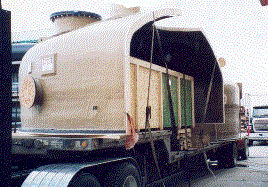 |
The FRP casing for the WESP is fabricating in the shop and shipped to site in pieces. It is generally desirable to have a complete domed roof section rather than having it split in two. Shipping restriction will generally dictate how the FRP casing is fabricated and whether or not it needs to be split. |
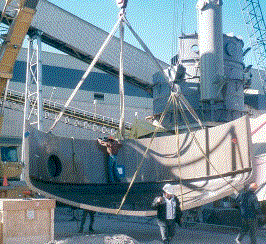 |
Once the casing is delivered to site it must be offloaded from the truck and positioned within the structure. Here a half section of the lower vestibule is being lifted and move into position. |
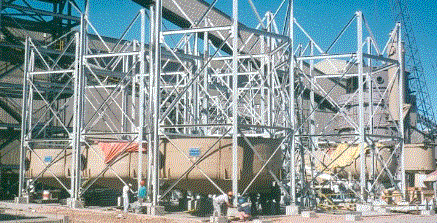 |
The lower vestibule is positioned within the supporting structural steel framework. Only a portion of the structural steel can be installed and not interfere with further assembly of the unit. |
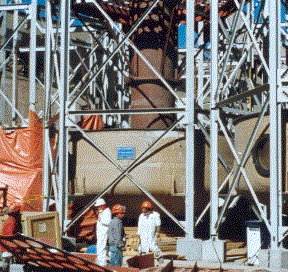 |
The upper tube sheet is placed into position supported by the structural steel. In this WESP design a core tube brings the gas down to the bottom allowing the gas to then flow upwards through the collection tubes. Here the upper tube sheet and core tube are in position ready for the installation of the collecting tubes. |
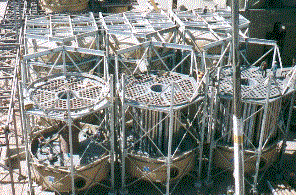 |
The lead tubes are lifted and inserted through the upper tube sheet and welded to the tube sheet. The photo shows three units in various stages of progress. Once all the tubes are in place, the upper vestibule is lifted in to place and the outer casing is added. |
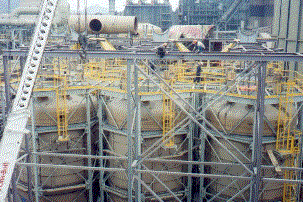 |
Once the WESP's are assembled the remaining structural steel is erected. Platforms, stairs and ladders are added to provided access for further construction. The last major lifts to be performed are the installation of the interconnecting ducting. In this design, all the ducting is on top of the WESP's. Some designs require ducting from the top of one unit to the bottom of the next unit. |