|
||
| Sulphuric Acid on the WebTM | Technical Manual | DKL Engineering, Inc. |
Knowledge for the
Sulphuric Acid Industry

Sulphuric Acid on the Web
Introduction
General
Equipment Suppliers
Contractor
Instrumentation
Industry News
Maintenance
Acid
Traders
Organizations
Fabricators
Conferences
Used
Plants
Intellectual
Propoerty
Acid
Plant Database
Market
Information
Library
Technical Manual
Introduction
General
Definitions
Instrumentation
Plant Safety
Metallurgial
Processes
Metallurgical
Sulphur Burning
Acid Regeneration
Lead Chamber
Technology
Gas Cleaning
Contact
Strong Acid
Acid Storage
Loading/Unloading
Transportation
Sulphur
Systems
Liquid SO2
Boiler Feed Water
Steam Systems
Cooling Water
Effluent Treatment
Utilities
Construction
Maintenance
Inspection
Analytical Procedures
Materials of Construction
Corrosion
Properties
Vendor Data
DKL Engineering, Inc.
Handbook of Sulphuric Acid Manufacturing
Order
Form
Preface
Contents
Feedback
Sulphuric Acid
Decolourization
Order Form
Preface
Table of Contents
Process Engineering Data Sheets - PEDS
Order
Form
Table of Contents
Introduction
Bibliography of Sulphuric Acid Technology
Order Form
Preface
Contents

Effluent Treatment -
Arsenic
June 26, 2003
|
Introduction Precipitation as Ferric Arsenate Precipitation Using Calcium Precipitation as a Sulphide References |
Associated Links |
|
Arsenic is present in
metallurgical off-gases as As2O3
Arsenic may also be present as As4, As2S3 and As2O3 (undissolved). All these forms of arsenic can be easily filtered and removed from the effluent stream.
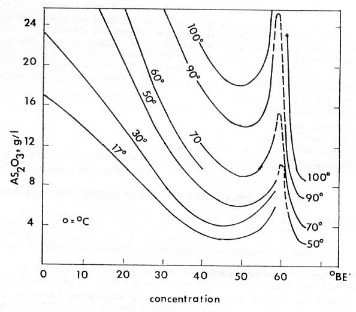
The chart on the right shows the solubility of arsenic in sulphuric acid solutions as a function of temperature. Arsenic is very soluble at low acid concentrations and high temperatures. In order to remove arsenic from the effluent the form the arsenic is in must be changed. Arsenic can be removed from weak acid effluent solutions in many forms. Some forms are very insoluble and have excellent long-term environmental stability while other forms can be easily re-dissolved.
Arsenic can
occur in two different oxidation states, as As3+ and As5+.
In order to ensure the maximum long-term stability of the precipitated arsenic
compounds, the arsenic must be in the As5+ state.
A strong oxidant such as hydrogen peroxide can easily oxidize any As3+
to As5+.
|
Precipitation as
Ferric Arsenate
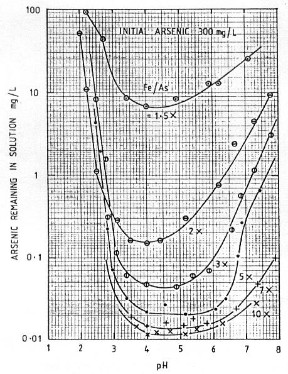
Ferric (Fe(III)) arsenate (FeAsO4·2H2O) is a very stable arsenic compound. It is soluble, but the solubility decreases rapidly as the ratio of iron to arsenic increases. The solubility of ferric arsenate can be reduce several orders of magnitude if four to five times the stoichiometric amount of iron is present in a pH range of 3.0 to 7.0. The chart on the right shows that at pH 4, the arsenic remaining in solution is about 8 mg/L at a Fe:As molar ratio of 1.5. Increasing the Fe:As ratio to 2 results in a significant reduction of arsenic in solution to about 0.15 mg/L. Further reduction of arsenic to about 0.02 mg/L can be obtained with a Fe:As ratio of 5.0. The data represented in the chart is experimental and represents near equilibrium conditions. Actual arsenic levels in operating systems will not achieve the same level of arsenic removal. We can see that at all Fe:As levels the minimum arsenic level in solution is obtained at about pH 4.
The reaction to convert soluble
arsenic acid to ferric arsenate occurs according to
the following reaction:
Fe2(SO4)3 + 2H3AsO4 => 2FeAsO4 + 3H2SO4
Laboratory precipitation test at a Fe:As ratio of 4, at 33°C and a retention time of 2 hours resulted in arsenic concentrations of 0.2 mg/L at pH 3.5 to 5.0. Higher precipitation temperatures has a negative effect on the solubility of arsenic. Therefore, it is desirable to precipitate arsenic at lower process temperatures. A chart showing results from this laboratory experiment are shown below.
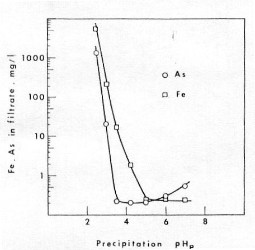 Variation of the residual As and Fe in the filtrate as a function of the precipitation pH. Tp=33°C, Fe/As=4. |
In most cases the effluent stream to be treated will contain other base metals such as Cu, Cd, Ni, Co and Zn. Experimental results indicate that the presence of excess ferric iron at the time of precipitation lead to increased arsenate stability. Excess ferric iron also assisted in maintaining the stability of metal arsenates when carbon dioxide (CO2) is present as is the case when effluent is stored in a pond or tailings area.
A typical block flow diagram of a arsenic precipitation process using ferric iron is illustrated below.
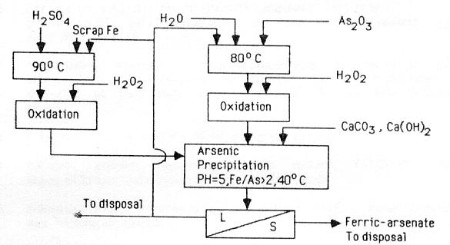 |
Block-diagram for the Fixation of As2O3 as Ferric Arsenate (FeAsO4) |
Precipitation of arsenic by calcium proceeds according to the following reactions:
2Ca2+ + 2AsO2- + 2OH- = Ca(AsO2)2 Ca(OH)2
4Ca2+ + 2AsO43- + 2OH- = Ca3(AsO4)2 Ca(OH)2
It has been documented in the literature that both calcium arsenite (Ca(AsO2)2) and calcium arsenate (Ca3(AsO4)2) are not appropriate forms due to their lack of stability. It was found that atmospheric carbon dioxide causes calcium arsenite and arsenate to decompose to calcium carbonate in alkaline solutions. Barium arsenate, magnesium arsenate and strontium arsenate are affected by carbon dioxide in a similar manner.
As well, calcium arsenate is relatively stable at pH’s of 8 to 11 but readily decomposes at lower pH values. If calcium arsenate is stored in a landfill slightly acidic rainfall or groundwater will result in calcium arsenate dissolving into solution.
Precipitation of arsenic as arsenous trisulphide (As2S3) in an acidic solution can be done by the addition of a sulphide such as Na2S, NaHS, or H2S. The resulting compound is stable and relatively insoluble which is contrary to most other metal sulphides which decompose to metal salts and H2S in an acidic solution. However, in alkaline solutions, arsenous trisulphide is fairly soluble. Therefore, removal of the precipitated arsenous trisulphide by filtration must be done while the solution is still acidic. Once the arsenic is removed, the solution can be neutralized for precipitation and removal of other impurities. Disposal of arsenous trisulphide by landfilling or tailings area is a problem since there is the potential that it will go back into solution.
Arsenic may also precipitate as FeAsS which appears to have low solubilities over a broad range pH range.
Stefanakis, M. and Kontopoulos, A., Production of Environmentally Acceptable Arsenites-Arsenates from Solid Arsenic Trioxide, Arsenic Metallurgy Fundamentals and Applications, 1988 TMS Annual Meeting and Exhibition, Pheonix, Arizona, January 25-28, 1988.
Robins, R.G., Huang, J.C.Y., Nishimura, T. and Khoe, G.H., The Adsorption of Arsenate Ion By Ferric Hydroxide, Arsenic Metallurgy Fundamentals and Applications, 1988 TMS Annual Meeting and Exhibition, Pheonix, Arizona, January 25-28, 1988.
Papassiopi, N., Stefanakis, M., and Kontopoulos, A., Removal of Asenic from Solution by Precipitation as Ferric Arsenate, Arsenic Metallurgy Fundamentals and Applications, 1988 TMS Annual Meeting and Exhibition, Pheonix, Arizona, January 25-28, 1988.