|
||
| Sulphuric Acid on the WebTM | Technical Manual | DKL Engineering, Inc. |
Knowledge for the
Sulphuric Acid Industry

Sulphuric Acid on the Web
Introduction
General
Equipment Suppliers
Contractor
Instrumentation
Industry News
Maintenance
Acid
Traders
Organizations
Fabricators
Conferences
Used
Plants
Intellectual
Propoerty
Acid
Plant Database
Market
Information
Library
Technical Manual
Introduction
General
Definitions
Instrumentation
Plant Safety
Metallurgial
Processes
Metallurgical
Sulphur Burning
Acid Regeneration
Lead Chamber
Technology
Gas Cleaning
Contact
Strong Acid
Acid Storage
Loading/Unloading
Transportation
Sulphur
Systems
Liquid SO2
Boiler Feed Water
Steam Systems
Cooling Water
Effluent Treatment
Utilities
Construction
Maintenance
Inspection
Analytical Procedures
Materials of Construction
Corrosion
Properties
Vendor Data
DKL Engineering, Inc.
Handbook of Sulphuric Acid Manufacturing
Order
Form
Preface
Contents
Feedback
Sulphuric Acid
Decolourization
Order Form
Preface
Table of Contents
Process Engineering Data Sheets - PEDS
Order
Form
Table of Contents
Introduction
Bibliography of Sulphuric Acid Technology
Order Form
Preface
Contents

Materials of Construction - Converters
October 9, 2001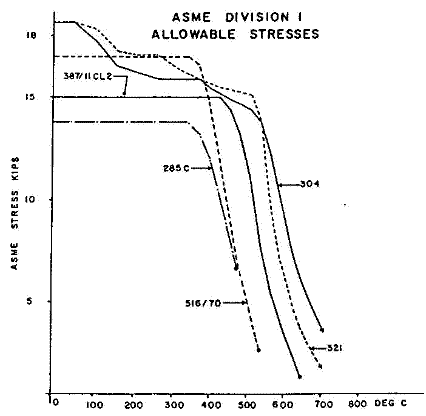
The operation of the converter is characterized by high temperatures in an oxidizing environment. With today's higher gas strengths operating temperatures in parts of the converter can exceed 625ºC (1157ºF).
The traditional materials of construction are carbon steel and cast iron. Today stainless steel is used for virtually all new converters.
The mechanical strength of carbon steel is reduced significantly at elevated temperatures. Grades of carbon steel commonly used in converter shells are A285 gr. C and A283 gr. C. Allowable stress values for these two materials are only quoted to 470ºC (878ºF) and 400ºC (752ºF) respectively. Allowable stress values for the best carbon steel (A516 gr. 70) is quoted only to 570ºC (1058ºF).
Allowable stress values for chrome-moly steel (387/11) are quoted over the normal operating temperature range of a converter. However, chrome-moly steel is difficult to weld and more expensive than plain carbon steel and offers no significant advantage from a corrosion point of view.
Type 304 stainless steel is the ideal material for the construction of a converter. Allowable stresses are acceptable up to the maximum operating temperature of a converter. The material offers good corrosion resistance, is readily available and easy to fabricate.
It should be noted that 304L SS is not an acceptable material of construction because of its maximum allowable stress values are only quoted to a maximum temperature of 426ºC (800ºF).
| Item | Material | Comments |
| Shell | Carbon Steel | Where operating temperatures exceed the allowable for carbon steel, bricklining may be used in combination with metallizing. |
| 304SS | 0.04% to 0.08% carbon | |
| 304H SS | 0.04% carbon minimum | |
| Catalyts Supports | Meehanite HS | Traditional material of construction in passes where operating temperature is high i.e. Beds 1 and 2. |
| Meehanite GE | Traditional material of construction in passes where operating temperature is low i.e. Beds 3 and 4. | |
| 304SS | 0.04% to 0.08% carbon | |
| 304H SS | 0.04% carbon minimum. | |
| Posts | Meehanite HR | Traditional material of construction |
| 304SS | 0.04% to 0.08% carbon | |
| 304H SS | 0.04% carbon minimum. Modern post and grid type converter. | |
| Baffle Plates | Meehanite GE | Traditional material of construction |
| Division Plates | Meehanite GE | Traditional material of construction |
| Screens | 304SS | 0.04% to 0.08% carbon |
| 321SS | Solution annealed hat treated at 1000ºC for 1 minute in a non-carburizing atmosphere. This forms the maximum amount of titanium carbide and minimizes the amount of chromium carbide. | |

