|
||
| Sulphuric Acid on the WebTM | Technical Manual | DKL Engineering, Inc. |
Knowledge for the
Sulphuric Acid Industry

Sulphuric Acid on the Web
Introduction
General
Equipment Suppliers
Contractor
Instrumentation
Industry News
Maintenance
Acid
Traders
Organizations
Fabricators
Conferences
Used
Plants
Intellectual
Propoerty
Acid
Plant Database
Market
Information
Library
Technical Manual
Introduction
General
Definitions
Instrumentation
Plant Safety
Metallurgial
Processes
Metallurgical
Sulphur Burning
Acid Regeneration
Lead Chamber
Technology
Gas Cleaning
Contact
Strong Acid
Acid Storage
Loading/Unloading
Transportation
Sulphur
Systems
Liquid SO2
Boiler Feed Water
Steam Systems
Cooling Water
Effluent Treatment
Utilities
Construction
Maintenance
Inspection
Analytical Procedures
Materials of Construction
Corrosion
Properties
Vendor Data
DKL Engineering, Inc.
Handbook of Sulphuric Acid Manufacturing
Order
Form
Preface
Contents
Feedback
Sulphuric Acid
Decolourization
Order Form
Preface
Table of Contents
Process Engineering Data Sheets - PEDS
Order
Form
Table of Contents
Introduction
Bibliography of Sulphuric Acid Technology
Order Form
Preface
Contents


Instrumentation - Pressure
August 21, 2001
|
Introduction Installation Ranges Chemical Seals |
Associated Links |
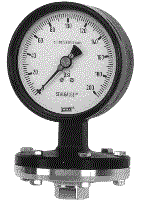
Pressure measurements are taken where ever th information will be useful for controlling, monitoring, or trouble shooting the process or equipment. Critical pressures should be available in the control room and if appropriate alarm levels set to inform operators when the pressure is outside its normal range.
Pump discharge pressures allow the operator to determine pump performance by taking pressure measurements and estimating flows from pump curves. Differential pressures if monitored and recorded over long periods of time can indicate when a catalyst bed, heat exchanger, column, filter, etc. is fouling or plugging up.
Pressure gauges should always be mounted with an
isolation valve so the gauge can be removed safely during operation. The
connection for the gauge is 1/2" NPT. The connection to the process line
and valve can be any size as long as the connection is reduced to 1/2" NPT for
mounting the gauge.
Standard ranges are given below. When specifying ranges the closes
standard range should be used that adequately covers the anticipated operating
range (ie. minimum to maximum).
| psi | Figure Interval | Graduations | kPa | Figure Interval | Graduations | |
| 15 | 1 | 0.1 | 100 | 10 | 1 | |
| 30 | 5 | 0.2 | 160 | 20 | 2 | |
| 60 | 5 | 0.5 | 250 | 50 | 2 | |
| 100 | 10 | 1 | 400 | 100 | 5 | |
| 160 | 20 | 1 | 600 | 100 | 5 | |
| 200 | 20 | 2 | 1000 | 100 | 10 | |
| 300 | 50 | 2 | 1600 | 200 | 20 | |
| 400 | 50 | 5 | 2500 | 500 | 20 | |
| 600 | 50 | 5 | 4000 | 1000 | 50 | |
| 800 | 100 | 10 | 6000 | 1000 | 50 | |
| 1000 | 100 | 10 | 10000 | 1000 | 100 |
Chemical seals should be considered where:
the process medium will corrode the transmitter connection and pressure
sensing element.
the process medium contains suspended solids or is sufficiently viscous to
clog the impulse piping.
the process temperature is outside of the normal operating limits of the
transmitter and cannot be brought into those limits with impulse piping.
the process medium might freeze or solidify in the transmitter or impulse
piping.
sanitary or aseptic conditions must be maintained.
there is a need to eliminate the maintenance requirements associated with wet
leg applications.
Based on the above guidelines, chemical seals are required on all strong acid,
weak acid, molten sulphur and wet process gas services. Utilities such as
air, water, steam, cooling water, process water will not require chemical seals.
Chemical seals come in a variety of materials including metals, PTFE, and
elastomers. Metals such as 304 SS, 316 SS, Hastelloy C (alloy C-276),
tantalum, Carpenter 20, Nickel 200, Monel 400, Inconel 600 and titanium are
available. Elastomer materials include viton, Buna N and neoprene.