|
||
| Sulphuric Acid on the WebTM | Technical Manual | DKL Engineering, Inc. |
Knowledge for the
Sulphuric Acid Industry

Sulphuric Acid on the Web
Introduction
General
Equipment Suppliers
Contractor
Instrumentation
Industry News
Maintenance
Acid
Traders
Organizations
Fabricators
Conferences
Used
Plants
Intellectual
Propoerty
Acid
Plant Database
Market
Information
Library
Technical Manual
Introduction
General
Definitions
Instrumentation
Plant Safety
Metallurgial
Processes
Metallurgical
Sulphur Burning
Acid Regeneration
Lead Chamber
Technology
Gas Cleaning
Contact
Strong Acid
Acid Storage
Loading/Unloading
Transportation
Sulphur
Systems
Liquid SO2
Boiler Feed Water
Steam Systems
Cooling Water
Effluent Treatment
Utilities
Construction
Maintenance
Inspection
Analytical Procedures
Materials of Construction
Corrosion
Properties
Vendor Data
DKL Engineering, Inc.
Handbook of Sulphuric Acid Manufacturing
Order
Form
Preface
Contents
Feedback
Sulphuric Acid
Decolourization
Order Form
Preface
Table of Contents
Process Engineering Data Sheets - PEDS
Order
Form
Table of Contents
Introduction
Bibliography of Sulphuric Acid Technology
Order Form
Preface
Contents


Acid Plant Database September 3, 2026
| Owner | Mississippi Phosphate Corporation |
|
||
| Location | P.O. Box 848 601 Industrial Road (Highway 611) Pascagoula, Mississippi USA 39568 |
|||
| Background | Formerly - Coastal Chemical Corporation - Mississippi Chemical and Coastal Chemical merge in 1972 - Nu-West Industries (Englewood, CO) purchase site in 1988 under the name Nu-South - Mississippi Phosphates Corporation acquires site in December 1990 Parent Company: MIssissippi Chemical Corporation |
|||
| Website | www.missphosphates.com | |||
| Plant | Plant No.1 | Plant No. 2 | Plant No. 3 | |
| Coordinates* | - | 30° 21' 6" N, 88° 30' 1" W | 30° 21' 5" N, 88° 30' 3" W | |
| Type of Plant | Sulphur Burning | Sulphur Burning | Sulphur Burning | |
| Gas Source | Elemental Sulphur | Elemental Sulphur | Elemental Sulphur | |
| Plant Capacity | Original: 545
MTPD Current: 907 MTPD |
Original: 1360 MTPD Current: 1588 MTPD |
Original: 1360
MTPD Current: 1588 MTPD |
|
| SA/DA | SA | 2/2 DA | 2/2 DA | |
| Emissions | - | - | - | |
| Status | 1975 Shutdown | Shutdown | Shutdown | |
| Year Built | 1958 | 1972 | 1974 | |
| Technology | MECS (Monsanto) | Outotec (Lurgi) | Outotec (Lurgi) | |
| Contractors | - | - | - | |
| Remarks | - | - | - | |
| Pictures | 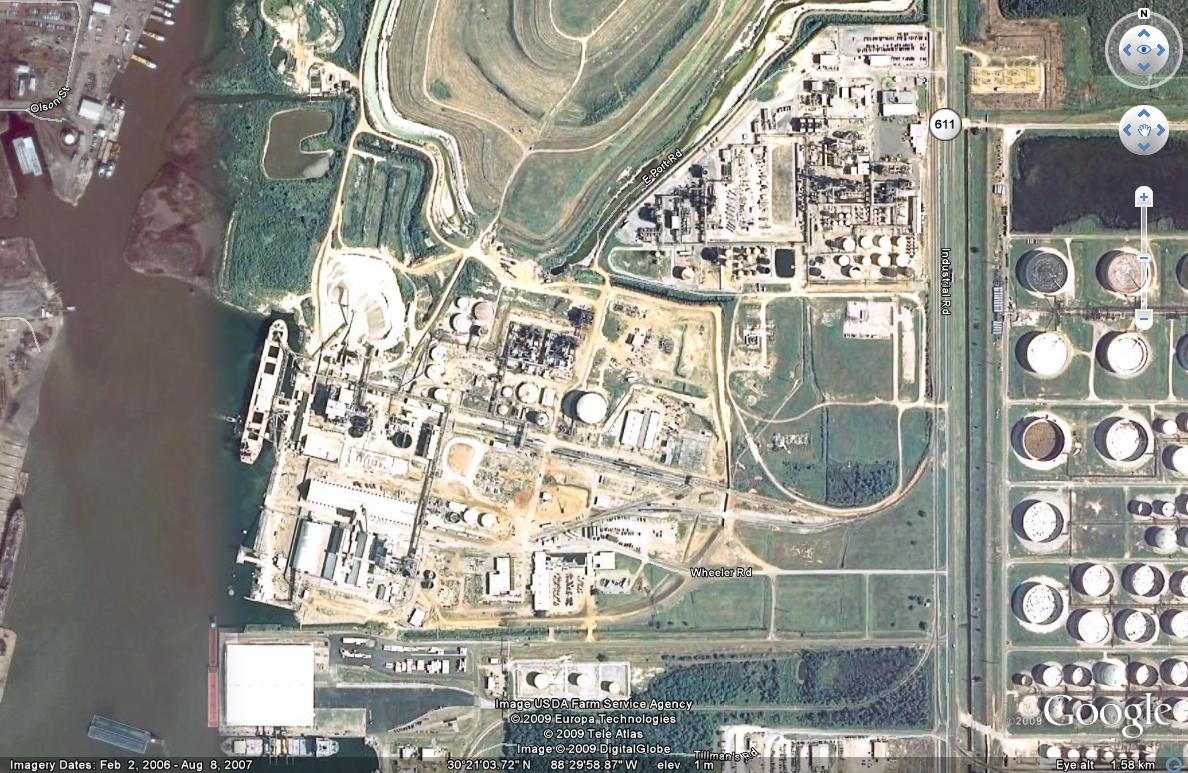 |
|||
| General | Mississippi Phosphates Corporation’s production facility is located in Pascagoula, Mississippi, and employs approximately 220 people. Mississippi Phosphates has the capacity to produce approximately 750,000 tons of diammonium phosphate (DAP) annually based on sulfuric acid produced at the site and approximately 870,000 tons annually if supplemental sulfuric acid is available for purchase. Two-thirds to three-quarters of this product is sold domestically, with the balance exported, primarily to Latin America. The Company’s export sales are marketed through Transammonia, Inc., a major global trading company. Mississippi Phosphates’ deep-water port facility on the Gulf of Mexico allows the Company to load ships for export directly from the plant site. Domestic sales of DAP are handled through the company’s internal sales staff and are distributed by rail, truck and barge. | |||
| Personnel |  Richard Johnson - Vice President of Operations Richard Johnson - Vice President of Operations |
|||
| Reference | - | |||
| News |
August
14, 2017 - The EPA is hosting a public meeting to explain the
process of getting Mississippi Phosphates on the Superfund National
Priorities List. It is taking public comment until Oct. 2. The
meeting begins at 6 p.m. Tuesday at the Pascagoula Senior Center, 1912 Live
Oak Ave. The EPA will explain the process and go over how to submit
comments. The agency also invites the public to speak, but the
comments won’t be recorded for the record. So if you plan to go and speak
your mind, bring your comments in writing as well. Local environmental
groups are urging people to make the trip. The Mississippi Phosphates
site is mountains of acidic byproduct from a fertilizer plant that operated
for 60 years along Bayou Casotte in east Pascagoula. One mound has been
sealed. The other has a wastewater pond that is producing 9 million gallons
of acidic water per inch of rainfall in the area. The gypsum in the mounds
is also moderately radioactive. The STEPS Coalition is reminding
people the meeting is an opportunity “to make direct comments, ask
questions, hold the officials accountable, and learn about the NPL process.
“The facility could potentially be sold and resume operations as before
under a new company, which would lead to even more pollution. Please come
out ... to make your voice heard,” it urged in a Facebook calendar post.
“This boondoggle is costing taxpayers a million dollars a month. It is a
looming disaster that results from weak permitting and lack of proper
oversight,” said Howard Page, community organizer for STEPS. He blames the
state Legislature for not properly funding the Mississippi Department of
Environmental Quality and the governor’s office for not supporting MDEQ in
its mission to protect public health and the environment. The EPA is
taking public comments online at regulations.gov or
via mail. Identify the Mississippi Phosphates site by docket number
EPA-HQ-OLEM-2017-0075. Or mail a comment to: US EPA, EPA Superfund
Docket Center, Mail Code 28221T, 1200 Pennsylvania Ave. NW, Washington, DC
20460. The EPA proposed Mississippi Phosphates as a superfund site.
The process now is to further investigate the need. The site is more
than 1,000 acres at 601 Industrial Road. The former diammonium phosphate
fertilizer plant used sulfuric acid during production, creating the acidic
byproduct. When the business filed bankruptcy and ceased operation in 2014,
it left 700 million gallons of untreated wastewater. EPA’s Superfund
program is responsible for cleaning up some of the nation’s most
contaminated land and responding to environmental emergencies, oil spills
and natural disasters. December 5, 2014 - Mississippi Phosphates, a major fertilizer producer in east Jackson County that has been plagued with environmental issues in recent years, announced today it will be stopping production of Diammonium Phosphate (DAP) early next week. Sulfuric acid operations will continue for several days in order for the company to establish inventory needed to support on-going wastewater treatment needs, a statement from the company said. The company filed for Chapter 11 bankruptcy protection with the U.S. Bankruptcy Court in Gulfport in October. The company, which employs about 200, announced a new CEO in August and that it had moved its corporate headquarters to the Pascagoula plant, located along the heavily industrial Bayou Casotte. A spokesman for Mississippi Phosphates, a wholly owned subsidiary of Phosphate Holdings, Inc., said sulfuric acid operations will continue at the plant for several days in order for the company to establish inventory needed to support on-going wastewater treatment needs. A landmark of the plant is the huge piles of spent sulfuric acid byproduct, an industrial type of gypsum, the acidic runoff of which must be maintained by a wastewater system. State and federal environmental agencies have expressed concern that if the company failed, maintaining the spent sulfuric acid stacks would become an expensive proposition. "The company will continue with other aspects of its core operations, including ammonia terminaling operations, maintenance, security and environmental controls," said Mississippi Phosphates CEO Steve Russo. "At this time, we do not know when DAP production might resume. The company is actively seeking buyers for its assets while we continue to move forward with the other elements of our bankruptcy case." Workforce reductions will occur over the next two weeks, with approximately 50 employees remaining on hand to perform the remaining core operations. On Tuesday, Mississippi Phosphates and representatives from the state held workforce transition meetings for all employees who were laid off at the company's Pascagoula facilities to assist them in finding jobs. Mississippi Phosphates is a Delaware corporation that operates the facilities in Pascagoula that produces DAP, the most common form of phosphate fertilizer for all major row crops, and sulfuric acid, as well as for the storage and terminalling of ammonia and sulfuric acid. October 27, 2014 - Mississippi Phosphates Corp. filed for Chapter 11 bankruptcy protection on Monday, seeking approval to continue to do business while its management sought additional funding to keep operating. The Pascagoula-based fertilizer manufacturer curtailed production last week of diammonium phosphat because of a shortage in raw materials but continued most of its other operations. Those include sulfuric acid, ammonia termina, dock and port, and all environmental systems, controls and monitoring, according to a company news release. “We expect that through this filing, we can gain needed relief, secure an updated credit and funding facility and return to production operations in an expedited manner,” Stephen S. Russo, chief executive officer of the company, said in the news release. “In addition to resuming operations, our plans call for the Company to continue maintenance and all environmental and safety programs during the reorganization.” Mississippi Phosphates Corp., a Delaware corporation, is a subsidiary of Phosphate Holdings Inc. It owns and oeprates manufacturing and distribution facilitieson a 40-acre industrial complex in Pascagoula. It produces agri-chemicals and fertilizer used as a source of phosphate on all major row crops. Formerly a part of Yazoo City-based Mississippi Chemical Corp., it emerged from bankruptcy in December 2004. The company also has been dealing with environmental issues the past few years. According to a Sun Herald report, in 2009, the federal Environmental Protection Agency ordered the company to fix uncontrolled leaks and spills of sulfuric acid on its grounds, and stop untreated discharges to the adjacent bayou and uncontrolled spills and leaks of phosphoric acid to unlined ditches. The newspaper said the agency found more issues in 2011, and in 2012, reinforced its orders to clean up, and last year, the state Department of Environmental Quality shut down two Mississippi Phosphat plants because they were creating an acid mist that caused neighboring industry to evacuate workers.
September 15, 2014 - An Environmental Protection Agency
inspector, during a tour of Mississippi Phosphates in 2009, walked through a
puddle so acidic it ate leather off the inspector’s steel-toed boots.
The inspector’s vivid account is one of dozens from an inspection
that year that yielded a biting administrative order from the EPA to the
company, using the words “imminent and substantial” danger when referring to
the possible impact on human health or the environment.
The federal agency ordered the company to fix uncontrolled leaks and
spills of sulfuric acid on its grounds, and stop untreated discharges to the
adjacent bayou and uncontrolled spills and leaks of phosphoric acid to
unlined ditches. The agency found more issues in 2011, and in 2012,
reinforced its orders to clean up. Then last year, the state Department of
Environmental Quality shut down two plants at the fertilizer manufacturer
because they were creating an acid mist that caused neighboring industry to
evacuate workers. All the while,
a neighborhood less than a mile away says it was unaware of the reports.
Cherokee Forest has 132 homes along heavily industrialized Bayou Casotte in
east Pascagoula, where several industries contribute heavily to air
emissions. Residents have been
complaining in recent years about thick dust, strong acrid smells and health
problems. They’ve told regulators what’s in the air and what’s on the ground
at neighboring industry is coming into their yards, onto their cars, onto
their skin and into their lungs.
The company says it has fixed its problems from the 2009 inspection.
“EPA conducted a final compliance inspection in October 2010 and
confirmed that MPC had implemented all the corrective action items addressed
in the 2009 order,” it said in a statement to the Sun Herald. Over the last
five years, MPC has continued to invest in its operation and environmental
programs and work with the EPA and Mississippi Department of Environmental
Quality to ensure future environmental compliance at the facility.”
So what’s the significance of the EPA inspector’s boot?
Howard Page, a community coordinator with the STEPS Coalition in
Biloxi, who helped organize the neighborhood into a group, said although
Mississippi Phosphates has made improvements, he believes the story of the
acid puddle is relevant today.
“It shows how very real the threat is,” Page said. “It’s not the most recent
event; things the company has been cited for and had to correct. But it
captures the issue — how strong that acid is.
“If it does that to a boot, just imagine what it does when you’re
breathing it as a mist. It’s a concrete example of what people are facing,
not just odors or a possible concern.”
Mississippi Phosphates said it pledged more than $2.5 million to
cleanup what the EPA found in 2009, has made other improvements and more
recently has offered air monitors in the neighborhood to detect sulfuric
acid. But Page said he believes
the chronic history of problems, “not one or two times, but a long series of
incidents” presents a health threat to workers and nearby residents.
He said there’s a need to control the risk to workers and neighbors.
“The process they operate there that involves acid is a potentially
dangerous process if it’s not managed and overseen well,” he said.
Page said one issue for the neighborhood has been substantiating
their complaints. And though other industries are putting dust and chemicals
in the air, remarks of trained EPA inspectors at Mississippi Phosphates in
the 2009 report sound familiar to residents:
• “the sampling team tasted a metallic flavor in the air that permeated to
the back of the throat. Sampling team members complained of burning,
stinging and itchy skin and eyes. The metallic taste remained with EPA
personnel for at least two days after leaving the site.”
• “The ongoing inhalation of sulfuric acid mist may pose substantial harm to
personnel at and visitors to the facility.”
• “The effects of discharges . extend far beyond the initial discharge zone,
reaching to the other side of Bayou Casotte, and far into the commercial
turning basin (of the bayou).”
• “Low pH liquids facilitate the mobilization of metals such as arsenic,
cadmium and chromium. Metals are readily leached from the soils and or
sediment into groundwater upon contact with a solution of pH less than 3.5.”
The puddle one inspector stepped in had a pH of less than 2 (the company’s
permit allows a range of 6 to 9).
Today, the residents, complaining of health issues, find it is up to them to
chase complaints and prove their case. And Page pointed out local
government, the Department of Environmental Quality and the industries are
also at the table looking for solutions.
Barbara Weckesser, who leads the neighborhood group, said she had
representatives from all four industries — Chevron Pascagoula Refinery,
First Chemical and VT Halter Marine and Signal International — in her
driveway last week, collecting dust samples and responding to reports of a
strong odor Aug. 29. The
neighborhood has put together an informal health survey that shows asthma
rates in adults well above the national average. They have made formal
comments on industries wanting to expand or to renew their air quality
permits. They’re learning.
Page said they met with the state Health Department and the
Department of Environmental Quality.
“Mississippi Phosphates says they think they’ve addressed their
issues. The others say the same,” he said. “But the citizens are having to
do the work. It’s on them, having to struggle to prove the case. They are
persistent, meeting the challenge to scientifically prove their suspicions
are correct.” They chase down
reports, try to determine which industry is creating dust or releasing
something with a strong odor, Page said, even as they are trying to carry on
with their lives, he said. “They
have to get up each morning and go to work.”
www.hattiesburgamerican.com
June 23, 2014 - Mississippi Phosphates will shut down its plant if sulfur dioxide levels read dangerously high, an official told east Pascagoula residents Monday night. The company presented an air monitor proposal to residents of the Cherokee neighborhood during a meeting at the Pascagoula Senior Center. The monitors will check for sulfur dioxide. The company has ordered two monitors at a total cost of $17,000. The monitors are expected to arrive within the next month and will be installed once permanent locations are determined. The monitors will read 24 hours a day. In the interim, company representatives are monitoring sulfur dioxide levels daily in the neighborhood with handheld monitors, said Kyle Mcculloch of Allen Engineering, which serves as a third-party to monitor readings. "It's a start. We're making progress," resident Julie Hambey said. "Maybe other companies will step up and monitor another chemical." Hambey said the smell in the community is overwhelming and often times causes her to have a headache along with an itchy throat and a burning sensation in her eyes. If levels of sulfur dioxide read high, the plant will shut down until corrections can be made, said Ajay Kumar, Mississippi Phosphates senior vice president and general manager of operations. The readings will be immediately reported to the MDEQ for further actions and emergency response. This may be a first for the Coast and even the state -- placing an air monitor in a neighborhood. Usually air quality monitors are placed in neutral locations that meet federal guidelines, the Mississippi Department of Environmental Quality said. There is already a monitor along U.S. 90 in West Pascagoula. Mississippi Phosphates installed monitors along its property line last fall. Officials said they have had monitors on their stacks. The company began emissions in 1958. Concerned Citizens of Cherokee, which hosted Monday night's meeting, was established by residents after years of dealing with air quality issues. Over the past couple of years, it has grown worse, they say, as dust settles thick on the 150 homes and an acrid odor lingers day and night. The Sun Herald was the first to reveal that the state issued a cease and desist order at Mississippi Phosphates in August 2013, requiring the facility to shut down because two neighboring industries reported sulfuric acid mist coming from the fertilizer plant. Those industries evacuated their employees, or sheltered them in place at times during July and August 2013, but no one warned the neighborhood, which is about a mile from the plant. Barbara Weckesser, president of Concerned Citizens of Cherokee, previously told the Sun Herald she learned that 60 percent of adults and children in the neighborhood have experienced sinus or respiratory problems in the past two years and 13 percent of residents have had pneumonia. Although she is glad the monitors are coming to her neighborhood, she wants to know that the smell, gray smoke and mist are also identified. Weckesser sustained sulfuric acid burns on her face that she says are still healing. No one has yet identified what causes the smell or physical symptoms, though company officials will monitor sulfur dioxide. Out of 2,900 chemical facilities in the nation, Mississippi Phosphates ranks 84th in toxic releases based on its release of 810,000 pounds of ammonia into the air each year. June 6, 2014 - Mississippi Phosphates Corp. reported a second minor sulfuric acid release on Thursday amid residents' intensifying worries about the health and environmental impacts of the diammonium phosphate fertilizer manufacturer. Mississippi Phosphates, which employs about 220 at its Industrial Road plant in east Jackson County, makes sulfuric acid and phosphoric acid to produce DAP fertilizer. The company notified the Mississippi Department of Environmental Quality and the National Response Center of the spill Thursday, MDEQ spokesman Robbie Wilbur said. "They assured us it had been contained on land and that they had begun cleaning it up," he said Friday, noting the agency is still collecting information on the incident. On May 28, Mississippi Phosphates reported low pH water from sulfuric acid released. The company's permit allows discharge with a pH in the range of 6-9. "We have been and will continue to closely monitor this facility and address issues when we need to," Wilbur said. "We take that responsibility very seriously." Citizens adjacent to the plant have most recently been complaining of odors, acid mists and other issues. Some of those residents organized a group called Cherokee Concerned Citizens to meet with industrial and regulatory representatives to voice their concerns, which include other businesses besides Mississippi Phosphates. "There seems to be a noticeable increase in reported incidents starting with the shut down last fall and numerous reports in the most recent months," Pascagoula councilwoman at large Brenda Simkins said of the company. "It feels like I am receiving a report every seven to 14 days, so one has to ask what the cumulative effect is even if each isolated incident is within regulatory guidelines," she said. "I am extremely concerned for the impact to our citizens, the environment and our other industrial partners." Late last year, MDEQ issued cease-and-desist orders for the company to shut down its sulfuric acid plants due to reports of an acid mist. The plant is now operating under restrictions that were handed down from the state in October. It's "imperative we develop an understanding of these increased activities such that we formulate an educated and objective assessment," Simkins said. "As a city, we will pursue answers to these questions and will continue to maintain the lines of communication between our citizens, MDEQ and our industrial partners." The DAP plant has a history of run-ins with state and federal regulatory agencies. Also last year, MDEQ had to issue a fishing and water contact closure for Bayou Casotte after a large fish kill was linked to low pH waters released from Mississippi Phosphates. In 2012, the Environmental Protection Agency ordered the company to take immediate action after corrosive water was discovered outside a perimeter dike. That order also directed Mississippi Phosphates to continue corrective actions included in a previous order from September 2009, when the EPA cited the company with leaks of sulfuric acid and untreated discharges from sulfuric acid plants to the adjacent bayou and leaks of phosphoric acid to unlined ditches. Also in 2012, the plant experienced two fatalities in explosions that occurred within two weeks of each other. Those incidents claimed the lives of 39-year-old Jeffrey Simpson and 20-year old Jeremy Moore. The U.S. Department of Labor's Occupational Safety and Health Administration later cited the plant with 40 safety and health violations related to the deaths.
May 30, 2014 - Fertilizer manufacturer Mississippi
Phosphates has put an emergency bypass in place to collect runoff from its
sulfuric acid plant that was going into a storm drain, according to a
published report Friday. The Mississippi
Press reports it has obtained documents that show the company notified the
U.S. Coast Guard National Response Center about the incident on Wednesday.
The plant has been operating under certain restrictions handed down
from the Mississippi Department of Environmental Quality in late October.
State regulators issued cease-and-desist orders in August and again
in September for Mississippi Phosphates to shut down their sulfuric acid
plants due to reports of an acid mist that was affecting residents in east
Pascagoula as well as other industries along Bayou Casotte.
The newspaper reports an email circulated among Jackson County
leaders and city of Pascagoula officials notes Mississippi Phosphates "has
started their emergency bypass of process water off the gypsum stack. They
are planning on a 10-day bypass."
The plant, owned by Madison-based Phosphate Holdings Inc.,
manufactures sulfuric acid and phosphoric acid to produce diammonium
phosphate fertilizer. It employs about 240 people in Pascagoula.
People in the area have formed the group Concerned Citizens of
Cherokee to document smells, dust and pollution and raising those concerns
with state and local officials and their industrial neighbors.
The group is also working with the Steps Coalition, which is helping
them target their efforts on the permitting process and further
documentation of the issues they face.
November 26, 2012 - Mississippi Phosphates Corp. has been cited by the government for 40 safety and health violations following the deaths of two workers in separate incidents at the company’s Pascagoula facilities. Occupational Safety and Health Administration says in a news release Monday that it has proposed penalties of $165,900. The company has 15 days to appeal. On May 22, a worker died while attempting to start up a steam turbine in sulfuric acid plant and being hit by flying metal debris when the turbine housing ruptured due to apparent over pressurization. In a similar incident on June 1, a worker restarting a tripped steam turbine in sulfuric acid plant also was killed by flying metal debris when the turbine housing ruptured due to over pressurization. OSHA cited other safety and health violations including exposing workers to “struck-by” hazards by not protecting them against over pressurization and failing to maintain and service equipment in accordance with the company’s maintenance program to prevent over pressurization. The company also was cited for failing to test and inspect pressure relief devices throughout the facility.
February 19, 2010 - Mississippi Phosphate Corp. and the
Environmental Protection Agency have agreed on how to fix environmental
violations remaining after a 2009 inspection, and some found last year.
Many actions were taken in 2009 to tackle problems found by the federal
agency, but it took more than two years to agree on all the terms and
permanent solutions, Richard Johnson, Mississippi Phosphate's vice president
of operations told The Mississippi Press. About 240 people work at the
plant owned by Phosphate Holdings Inc. of Madison. It makes sulfuric
acid and phosphoric acid for fertilizer. In 2009, the EPA said that
the plant posed a danger to health and the environment because of violations
including inadequate safety equipment, improper storage, leaks of sulfuric
acid, and leaks of phosphoric acid to unlined ditches. Company leaders
said then that fixing the problems would cost about $2.5 million. The
EPA's final order, outlining progress and required future actions, said many
of the original problems have been corrected but inspections last year found
"imminent and substantial" danger from corrosive water outside a perimeter
dike. Johnson said the dike is stable, but the water was seeping from
a stack closed in 2005. He said the company immediately neutralized the
liquid and made a berm of agricultural lime to keep the bayou safe during
heavy rains. Johnson said he plans to permanently fix the problem by
installing remediation wells.
November 10, 2011 - Phosphate Holdings, Inc. today reported a third quarter 2011 profit of $1.5 million, or $0.18 per diluted share of common stock, compared to earnings of $2.5 million, or $0.30 per diluted share of common stock for the same period in 2010. Total net sales for the third quarter of 2011 were $94.7 million, a 35 percent increase from total net sales of $70.4 million for the third quarter of 2010. The average sales price per short ton of DAP during the third quarter of 2011 was $578, a 27 percent increase from the prior-year period average sales price of $455. During the third quarter, the Company sold 162,761 tons of DAP, with 112,120 tons moving into domestic markets and 50,641 tons moving into export markets. This represents a 7 percent increase over the 152,500 tons sold in the third quarter of 2010. The Company recorded operating income of $2.7 million for the third quarter of 2011, compared to operating income of $3.9 million for the prior-year period. Earnings before interest, taxes, depreciation and amortization (EBITDA) for the third quarter of 2011 were $6.6 million, compared to EBITDA of $7.3 million for the third quarter of 2010. In the third quarter of 2010, EBITDA was favorably impacted by litigation settlements, net of related costs, of $0.8 million. DAP prices began the quarter at $595 per short ton, NOLA, and $645 per metric ton, FOB, U.S. Gulf. At quarter's end, DAP prices were $586 per short ton, NOLA, and $635 per metric ton, FOB, U.S. Gulf. Sulfur prices in the quarter were posted at $220 per long ton, CFR, Tampa. Ammonia prices began the quarter at $555 per metric ton, CFR, Tampa, and closed the quarter at $650 per metric ton, CFR, Tampa. Commenting on third quarter results, Robert E. Jones, Chief Executive Officer, said, "We are pleased to report positive third quarter results. Our third quarter EBITDA of $6.6 million represents a 234 percent improvement over our second quarter 2011 EBITDA level of $2.0 million. During the third quarter of 2011, we produced 167,000 tons of DAP, which is the highest DAP production level since our second quarter of 2009. However, sulfuric acid production in one of our two sulfuric acid plants operated throughout the quarter at substantially reduced rates due to a damaged heat exchanger. As a result, approximately 27 percent of our third quarter DAP production was produced with purchased sulfuric acid. DAP produced with purchased sulfuric acid had much lower margins than DAP produced with internally generated sulfuric acid. 'On October 21, 2011, we commenced a major maintenance turnaround during which we addressed all known issues constraining sulfuric acid production. During the course of the turnaround, work was performed on both sulfuric acid plants as well as on the phosphoric acid and DAP plants. The turnaround was completed on November 7, 2011 and, while no assurance can be given, we expect materially improved operating rates. Downtime associated with these maintenance activities will adversely impact fourth quarter operations. We are projecting DAP production of approximately 150,000 to 160,000 tons in the fourth quarter." Shifting to the near-to-intermediate-term industry outlook, Jones added, "A very late harvest in much of the U.S. has delayed and will shorten the domestic fall application season. As a result, demand has been soft and DAP prices have declined from $615, on August 1, 2011 to a current level of $565 per short ton, FOB, NOLA. Looking beyond the 2011 fall season, market underpinnings appear strong with high grain prices, historically low grain stocks and a promising demand outlook for the 2012 spring season." As of September 30, 2011, the Company had a cash balance of approximately $4.3 million and borrowings under our revolving credit agreement of $7.5 million. The Company continues to aggressively manage its liquidity and believes that its operating results and available credit facilities should be adequate to meet the Company's financing needs for the foreseeable future. At the end of 2010, our Board of Directors appointed a special committee of independent directors to initiate a comprehensive review of strategic options. While this review is ongoing, we will not hold an earnings call to discuss our third quarter 2011 financial results and will not otherwise discuss this strategic process. When the strategic process is completed, we intend to resume regular quarterly earnings calls. The Company is a Delaware corporation and the sole stockholder of Mississippi Phosphates Corporation. Mississippi Phosphates Corporation is a Delaware corporation with its executive headquarters in Madison, Miss. Mississippi Phosphates Corporation owns and operates manufacturing facilities in Pascagoula, Miss., which produce diammonium phosphate, the most common form of phosphate fertilizer used as a source of phosphate on all major row crops.
August 11, 2011
- Phosphate Holdings, Inc., today reported a second quarter 2011 loss of
$1.8 million, or $0.21 per diluted share of common stock, compared to a loss
of $4.9 million, or $0.58 per diluted share of common stock for the same
period in 2010. Earnings before interest, taxes, depreciation and
amortization (EBITDA) for the second quarter of 2011 were $2.0 million,
compared to negative EBITDA of $4.6 million for the second quarter of 2010.
May 12, 2011 - Phosphate Holdings,
Inc. today reported a first quarter 2011 net income of $16,000, compared to
net income of $2.6 million for the same period in 2010. The Company achieved
operating income of $53,000 for the first quarter of 2011, compared to
operating income of $4.2 million for the prior-year period. Earnings before
interest, income taxes, depreciation and amortization (EBITDA) for the first
quarter of 2011 were $3.8 million, compared to EBITDA of $7.2 million for
the first quarter of 2010. Net
sales for the first quarter of 2011 were $77.6 million, a 29 percent
increase over net sales of $60.1 million for the first quarter of 2010. The
average sales price per short ton of DAP for the first quarter of 2011 was
$539, which represents a 1 percent increase over the fourth quarter of 2010
average sales price per short ton of DAP, which was $534, and a 30 percent
increase over the first quarter of 2010, which was $415. During the first
quarter of 2011, the Company sold 140,968 short tons of DAP, with 81,606
short tons moving into domestic markets.
Robert E. Jones, Chief Executive Officer, said, “During the first quarter of
2011, our DAP production was impacted by phosphate rock shortages. Severe
flooding in Morocco interrupted rock deliveries from the mines to the port
causing significant delays in the delivery of phosphate rock to our
facility. As a result, we curtailed production during late January and early
February to avoid a complete shutdown of our phosphoric acid and DAP
granulation plants. As phosphate rock deliveries resumed, we experienced
strong DAP granulation results, with 61,885 short tons produced in March
2011. This represents our highest monthly DAP production level in four
years. Total DAP production in the first quarter of 2011 was 149,031 short
tons. “Early in our second
quarter, we experienced additional delays in phosphate rock deliveries,
again due to logistical difficulties in Morocco. These delays will result in
a shutdown of our DAP granulation and phosphoric acid plants for
approximately eight days in early May 2011. To mitigate the impact of this
shutdown, we advanced a planned maintenance turnaround on one of our
sulfuric acid plants. Both the planned and unplanned outages will impact our
second quarter DAP production volumes, which we currently project to be
140,000 to 150,000 short tons.
“From a market perspective, the average posted DAP price was $550 per short
ton (NOLA), in the first quarter of 2011. Sulfur prices in the first quarter
were posted at $185 per long ton (CFR, Tampa). Ammonia prices began the
first quarter at $475 per metric ton (CFR, Tampa), and closed the first
quarter at $555 per metric ton (CFR, Tampa).”
May 3, 2011
- Mississippi Phosphate Corp.'s Pascagoula plant
has remedied all of its small violations cited by the Environmental
Protection Agency in 2009, leaders said, but the company awaits EPA approval
before implementing plans to fix the larger issues.
"We're still working with the EPA, and all of that has gone very well," said
Richard Johnson, president of operations. "We have proposals on ways to
correct the larger problems that are currently being evaluated by the EPA,
and the smaller items are taken care of."
The company, which is owned by Madison-based Phosphate Holdings Inc. and
employs about 260, manufactures sulfuric acid and phosphoric acid to produce
diammonium phosphate, or DAP, fertilizer.
In summer 2009, the EPA and Mississippi Department of Environmental Quality
inspected and took samples around the plant.
According to the order issued following those visits, violations included
inadequate safety equipment, improper storage and spills and leaks of solid
and liquid wastes. "Throughout
their inspections and investigations, they identified some problems that we
didn't know we had," Johnson said.
The more serious violations principally involved the sulfuric acid plant,
Johnson said. "We had some soil
samples that came back with a low pH," he said. "We need to remediate that
soil." The less serious
environmental issues already taken care of included mitigating surface water
contamination and providing chemical-resistant clothing for employees.
The plant, which opened in 1958, has separate plants on site that
manufacture sulfuric acid, phosphoric acid and DAP.
"We've dedicated the time and the money and the resources to get those items
corrected," Johnson said. As of
Dec. 31, the company has spent $5.4 million toward the environmental
remediation effort. "Now we're
kind of in the wait mode until we get approval," Johnson said. "From the
time that EPA says our plan is good, it'll take us a year and a half to
implement that plan."
May 2, 2011 - When a company has no control over the costs of its raw materials, it had better produce a steady stream of product, said Richard Johnson, Mississippi Phosphates Corp.'s vice president of operations. The company, which was spun off from the bankrupt Mississippi Chemical Corp. in late 2004, manufactures sulfuric acid and phosphoric acid to produce diammonium phosphate, or DAP, fertilizer. The company's three raw materials -- phosphate rock, ammonia and sulfur -- are all subject to large price fluctuations said Johnson, a Gulfport native who returned to the coast in November to take his current job. "The fertilizer business as a whole is rocky," Johnson said. "It is so influenced by factors we can't control, such as the cost of our raw materials, fuel costs, weather conditions in the Midwest and even foreign governments." For example, the industry suffered when China decided it would stop importing DAP and make its own, he said, and India subsidizes its farmers, so the government sets the price and volume of product that will be imported each year. And DAP itself has experienced dramatic price fluctuations in the 30 years that Johnson has been in the industry, he said, as low as $175 and as high as $1,300 per ton. "It's a roller coaster ride you really don't want to take," Johnson said. Additionally, Mississippi Phosphate is "really small relative to our competition," he said. "We don't get to set the price," he said. "DAP is truly a world commodity, and we don't have the ability to pass on the costs of our raw materials to the customer." What all of that means for Mississippi Phosphates, Johnson said, is that the plant has to be well maintained so it can keep pumping out product. "The key to it is that we're not in charge of the price and we're not in charge of the raw materials, so the more volume we can make, the better off we'll be," he said. "We just have to make the plant run." On average, the company makes about 2,400 tons a day, which is sold domestically and abroad in places such as Latin America, India, Pakistan and "wherever the market calls for," he said. The plant employs about 250 people in Pascagoula and about 10 at the corporate headquarters in Madison. Johnson said he's very pleased with his employees so far. March was especially productive, he said, as the plant produced 61,000 tons of DAP, the most it has produced in one month in the last three years. "For an older plant, that's pretty good," he said, noting the plant opened in 1958.
November 9, 2010 - During its third fiscal quarter of 2010,
production problems impaired the Company's ability to fully participate in a
rapidly improving phosphate market. A waste heat boiler in one of the
Company's sulfuric acid plants, which failed during June 2010, was repaired
by the end of the second quarter; however, collateral damage to other parts
of the plant caused by the boiler failure could not be addressed until the
scheduled maintenance turnaround currently underway. For the third quarter,
the Company's sulfuric acid production was approximately 187,000 tons, or 77
percent of originally planned levels. Reduced sulfuric acid production had a
corresponding unfavorable impact on DAP production, which was approximately
156,000 short tons. "On November 1,
2010, we commenced a major maintenance turnaround during which we plan to
address all known issues constraining sulfuric acid, phosphoric acid and DAP
production. During the course of the turnaround, work will be performed on
both sulfuric acid plants as well as on the phosphoric acid and DAP plants.
The downtime associated with these maintenance activities will adversely
impact fourth quarter operations. For the quarter, we are projecting DAP
production of approximately 140,000 to 150,000 tons. While no assurance can
be given, we currently expect to emerge from the November turnaround at
materially improved operating rates."
2010 2nd Q Report - Second quarter 2010 operating results were negatively impacted by plant production issues. Sulphuric acid production was approximately 66% of planned levels. Production rates at both sulphuric acid plants were impacted by problems with the interstage absorption coolers. Moreover, a boiler failure in one of the sulphuric acid plant which shut that sulphuric plant down for 27 days during the quarter. The boiler has been repaired and the sulphuric acid plant came online on June 24, 2010. As a result of the boiler failure and the lost sulphuric acid production, sulphuric acid was purchased to augment DAP production. The purchased sulphuric acid did not provide the same margins as produced sulphuric acid. To provide adequate steam for the phosphoric acid and DAP granulation plant, the auxiliary boilers were operates which added approximately $0.5 million in additional natrual gas costs. The boiler failure also impacted other areas of the plant and contributed to a sharp increase in maintenance expense during the quarter. Second quarter maintenance expenses were over $1.0 million above the prior year second quarter levels.
2010 1st Q Report - Operational issues negatively impacted the Company's results. Production fo DAP was approximately 78% of planned production levels for the quarter. The shortfall resulted from various unplanned outgaes in the sulphuric acid plants. Various factors, including extreme cold temperatures and heavy rainfall events, contributed to these unplanned outages. Additionally, a planned maintenance turnaround was taken on the No. 2 sulphuric acid plant during the this period. Subsequent to the turnaround problems with the coolers in the interstage absorption towers developed requiring replacement of the coolers.
November 20, 2009 - It will likely cost about $2.5 million to
correct environmental violations cited at the Pascagoula Mississippi
Phosphates plant this summer, company leaders said Thursday during a
third-quarter conference call. In August, the Environmental Protection
Agency ordered the company to correct spills, improper storage and other
violations found during an inspection by EPA and the Mississippi Department
of Environmental Quality. Mississippi Phosphates makes sulfuric acid
and phosphoric acid to produce diammonium phosphate, or DAP, fertilizer.
The EPA said the plant posed a danger to health and the environment.
Violations there include inadequate safety equipment, improper storage, and
spills and leaks of solid and liquid wastes. The company said Thursday
that it had spent about $600,000 toward groundwater remediation and expected
to spend up to $2.5 million to remedy all the violations. That total
does not include any potential civil penalties sought by EPA and MDEQ, said
Robert Jones, the company's chief executive. To date, the company has
"either complied with each and every dictate or submitted a plan of
compliance and are awaiting EPA response," he said. Madison,
Miss.-based Phosphate Holdings Inc., which owns the 230-employee plant in
Pascagoula, saw sales and profit fall in the third quarter. The
company reported earnings of $724,000, compared to earnings of $12.6 million
in the same quarter of 2008. The company lost $10.7 million in the
nine months that ended Sept. 30. Company officials said they are
optimistic about the fourth quarter. "DAP prices are
increasing," Jones said. "The outlook is firm, primarily driven by continued
demand in China." The average price of DAP in the third quarter was
$267 per ton, he said, in contrast to averages above $1,000 per ton in 2008.
Jim Perkins, who oversees sales and marketing, said the company looks
forward to a "robust spring season," as farmers who saw bumper crops should
have money to buy fertilizer.
September 30, 2009 -
The Environmental Protection Agency has ordered a Pascagoula chemical
company to correct problems it says have resulted in "an imminent and
substantial danger to human health and the environment."
The Sun Herald in Gulfport/Biloxi reports EPA issued its order to
Mississippi Phosphates, which manufactures sulfuric acid, phosphoric acid
and phosphate-based fertilizer. EPA and the Mississippi Department of Environmental Quality
inspected the plant during the summer. EPA said hazardous materials were
found in soil and water at the site.
The agency blamed the problems on numerous spills of solid and liquid
hazardous wastes. |
|||
MTPD - Metric Tonne per Day
STPD - Short Ton per Day
MTPA - Metric Tonne per Annum STPA - Short Ton per
Annum
SA - Single Absorption
DA - Double Absorption
* Coordinates can be used to
locate plant on Google Earth