|
||
| Sulphuric Acid on the WebTM | Technical Manual | DKL Engineering, Inc. |
Knowledge for the
Sulphuric Acid Industry

Sulphuric Acid on the Web
Introduction
General
Equipment Suppliers
Contractor
Instrumentation
Industry News
Maintenance
Acid
Traders
Organizations
Fabricators
Conferences
Used
Plants
Intellectual
Propoerty
Acid
Plant Database
Market
Information
Library
Technical Manual
Introduction
General
Definitions
Instrumentation
Plant Safety
Metallurgial
Processes
Metallurgical
Sulphur Burning
Acid Regeneration
Lead Chamber
Technology
Gas Cleaning
Contact
Strong Acid
Acid Storage
Loading/Unloading
Transportation
Sulphur
Systems
Liquid SO2
Boiler Feed Water
Steam Systems
Cooling Water
Effluent Treatment
Utilities
Construction
Maintenance
Inspection
Analytical Procedures
Materials of Construction
Corrosion
Properties
Vendor Data
DKL Engineering, Inc.
Handbook of Sulphuric Acid Manufacturing
Order
Form
Preface
Contents
Feedback
Sulphuric Acid
Decolourization
Order Form
Preface
Table of Contents
Process Engineering Data Sheets - PEDS
Order
Form
Table of Contents
Introduction
Bibliography of Sulphuric Acid Technology
Order Form
Preface
Contents

Acid Plant Database November 6, 2024
| Owner | Atlantic Copper |
|
||
| Background |
Formerly - Rio Tinto Company, Ltd. 1977 - Name Changed to Rio Tinto Minera, S.A. 1995 - Atlantic Copper, S.A. formed from the smelting and refining part of the business 1998 - Freeport-McMoRan Copper & Gold Inc. becomes sole shareholder of the company www.fcx.com |
|||
| Location | Avda./ Francisco
Montenegro, s/n 21001 Huelva Spain |
|||
| Website | www.atlantic-copper.es | |||
| Plant | Plant No. 1 | Plant No. 2 | Plant No. 3 | |
| Coordinates* | 37° 13' 38" N, 6° 56' 52" W | 37° 13' 37" N, 6° 56 '51" W | 37° 13' 42" N, 6° 56' 46" W | |
| Type of Plant | Metallurgical | |||
| Gas Source |
Copper Outotec Flash Furnace Peirce-Smith Converters (2 blowing, 2 standby) |
|||
| Gas Cleaning | Lurgi: Radial Flow Scrubbers (8) - Gas Cooling Tower (4) - 1st Stage WESP (5) - 2nd Stage WESP (5) |
|||
| Plant Capacity | 1550 MTPD(1) (1735 MTPD) 180,000 Nm3/h, 5-10% SO2 |
550
MTPD(1) (700 MTPD) 65,000 Nm3/h, 6-9% SO2 |
900 MTPD(1) (1267 MTPD) 115,000 Nm3/h, 5-11% SO2 |
|
| SA/DA | 3/2 DA, > 99.6% | DA, >99.6% | 3/2 DA, >99.8% | |
| Emissions | - | - | - | |
| Status | Operating | Operating | Operating | |
| Year Built | 1971 | 1975 | 1996 | |
| Technology | Outotec (Lurgi) | Outotec (Lurgi) | Outotec (Lurgi) | |
| Contractors | Outotec (Lurgi) | Outotec (Lurgi) | Outotec (Lurgi) | |
| Remarks | - | - | - | |
| Pictures | 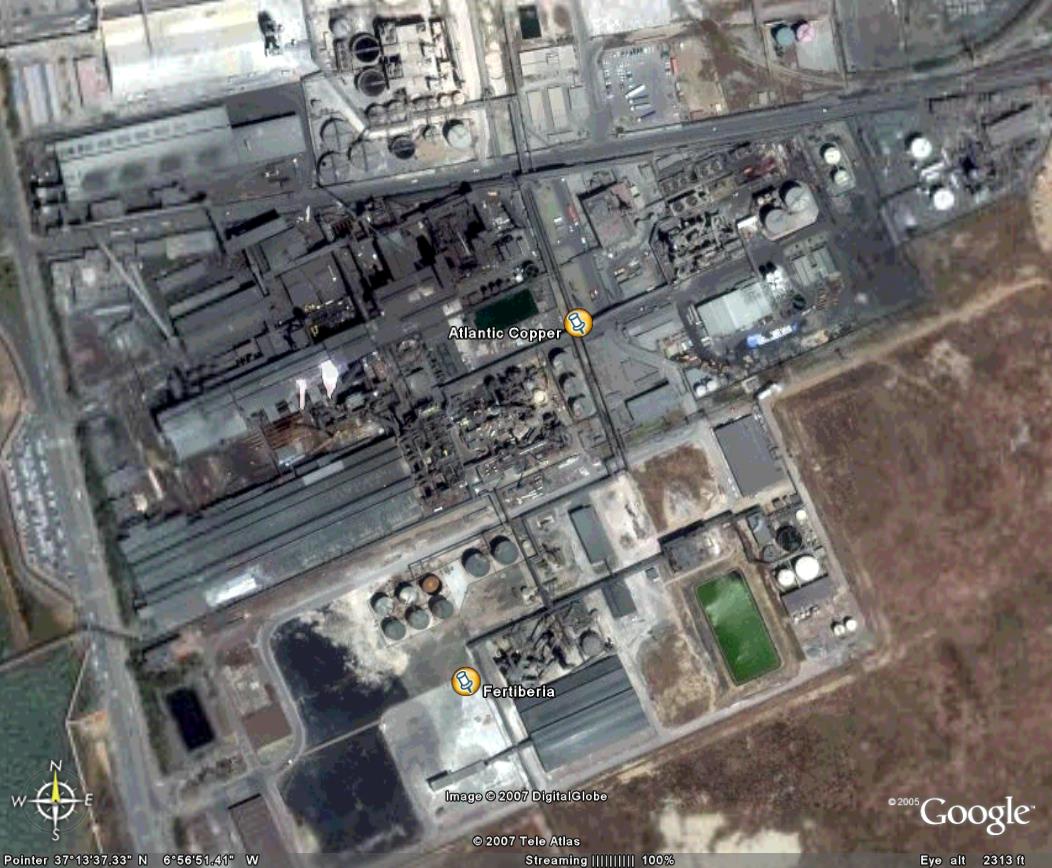 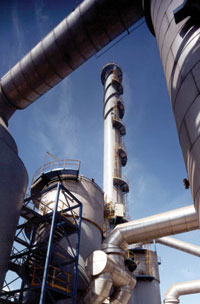 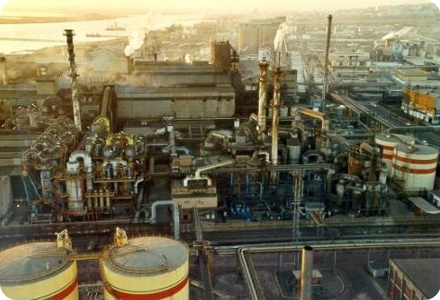 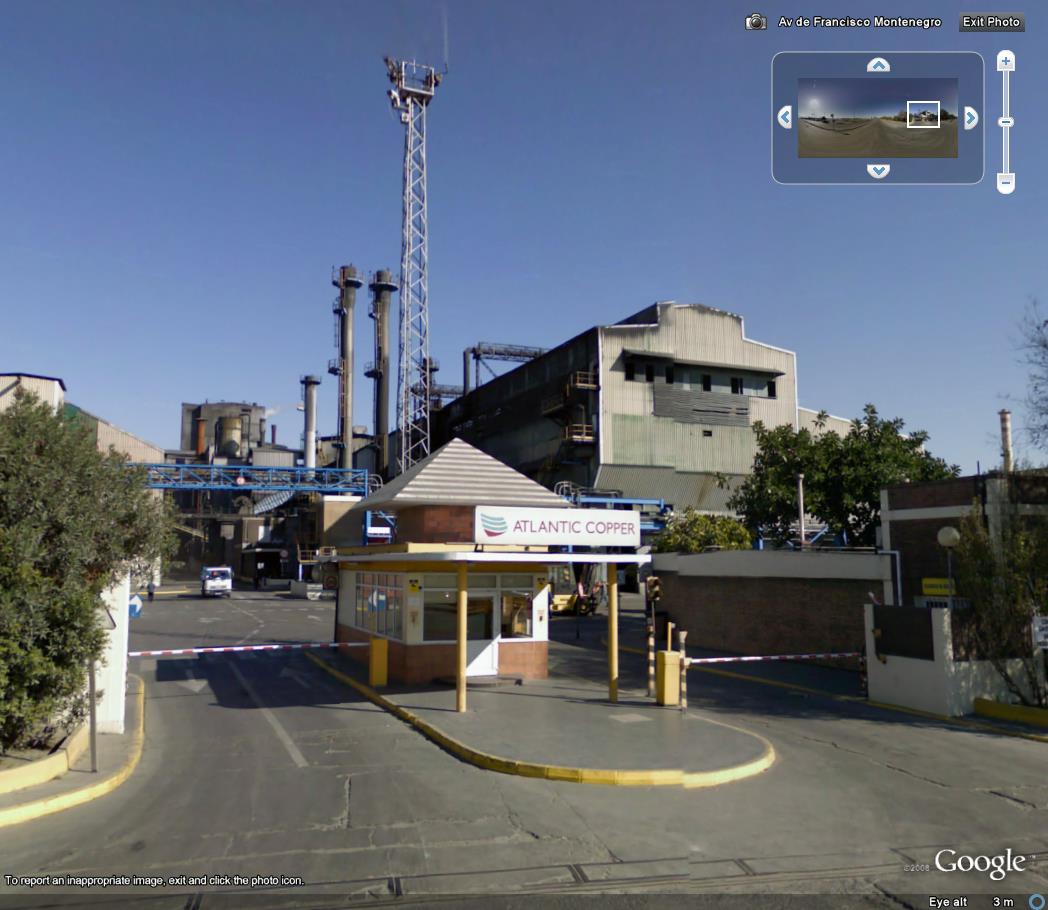 
 |
|||
| General | The history of
Atlantic Copper dates back to 1873, when a group of British bankers and
businessmen purchased the Rio Tinto mines from the Spanish Government to
establish The Rio Tinto Company, Ltd. At its peak, there were some 14,000
workers, 150 kilometers of railway track and a pier in the port of Huelva
where copper and pyrite ore were loaded for export.
In 1970, the smelter and refinery were commissioned next to the
port of Huelva . In 1993 Freeport-McMoRan Copper & Gold Inc acquired Rio
Tinto Minera, S.A. beginning a new era for the company, with the
rationalization and growth of its industrial activity. 1994,
the company decided to concentrate its efforts on the metallurgy business,
investing more than 200 million euros to double Huelva's smelting and
refining capacity and ensure the company's compliance with environmental
requirements. Following the expansion of the
Huelva plant, by 1996 the company reached a production capacity of 310,000
MT of copper anodes and a refining capacity of 260,000 MT of cathodes,
smelting more than one million MT of copper concentrate.
Atlantic Copper sold its assets in Córdoba (Colada Continua) and
Barcelona (Trefilería) to focus exclusively on the production of primary
copper from copper concentrate. Today, Atlantic
Copper is the heir to a long tradition resulting from years of experience
and a staff of professionals who have built the company into a very
important actor in the production of copper: a raw material that can be
recycled indefinitely and therefore contributes to the sustainability of
human development.
Atlantic Copper is one of the world's most important producers of copper.
Thanks to investments and the rationalization of our productive process, we
are capable of producing approximately 310,000 MT of copper anodes, 260,000
MT of which are refined into copper cathodes with a copper content of more
than 99.99%; the main by-products are sulfuric acid (around 1 million MT)
and electrolytic slimes rich in gold ( 25 MT) and silver ( 75 MT) . The
principal raw material is copper concentrate which Atlantic Copper receives
from mines, smelting approximately one million MT. The terminal includes the following installations: • One storage tank of 12,000 MT. |
|||
| Reference | (1) Sulphur 2014, "Smelter Acid Outlook", Ricardo Martinez Sanz | |||
| News |
October 2, 2009 - Spain's Atlantic Copper, part of Freeport McMoRan
Copper & Gold Inc., has raised production at its Huelva smelter by 10-15
percent since the beginning of August, it said on Friday. A company
official said the increase would raise the smelter's output to 300,000
tonnes per year of copper anodes and was due to improvements in efficiency
and using more oxygen in the furnace. Anodes are basic copper blocks
that are later refined. Encouraged by higher prices, some metal
producers have started to reverse earlier cutbacks and project delays,
prompted around mid-2008 by plunging demand. The official added that
Atlantic Copper was selling all the sulphuric acid produced by the smelter,
despite a leading client closing a plant in the southwestern port of Huelva.
"We are placing all of our acid," the official said. Fertiliser maker
Fertiberia used to buy 30 percent of the 1 million tonnes of sulphuric acid
-- a by-product of copper smelting -- produced annually in Huelva.
Spanish farmers say they have used a lot less fertiliser this year because a
collapse in grain prices GRAES01 has forced them to cut back on production
costs. The official added that Atlantic had invested 20 million
euros ($29 million) in the past two years in extending port facilities to
handle acid. Clients included parent company Freeport's installations in
the Americas, a net importer of sulphuric acid produced in Europe and Asia.
Last year, Atlantic Copper said it sold about 300,000 tonnes of sulphuric
acid a year on the spot market, which it hoped to raise to 500,000 a year in
2009 and 2010. Some copper and zinc smelters were forced to cut their
output earlier this year because they ran out of space to store hazardous
sulphuric acid in the face of poor demand for the by-product. However,
some plants have returned to full production due to improvements in the
sulphuric acid market. September 24, 2009
- Atlantic Copper can offload the sulphuric acid produced by its copper
smelter even though Fertiberia, a Spanish fertiliser company and a major
consumer of its by-product, has shut its plant in Huelva, Spain, according
to a company official. Concerns have mounted about how the Spanish smelter
has been getting rid of its sulphuric acid after Fertiberia shut one of its
fertiliser plants in Huelva, where the Spanish producer has its own plant.
“We’re placing all our sulphuric acid,” the official said. Fertiberia shut
its plant several months ago, although there is talk the the company is
looking to reopen it, according to market sources. About 30% of Atlantic
Copper’s sulphuric acid output, equivalent to 300,000 tpy, was feeding
Fertiberia before the closure, with the rest being shipped to the Americas,
where Freeport uses acid for leaching, and to Europe, the Mediterranean and
Morocco. There is a strong fertiliser industry in Morocco, market
participants said. |
|||
MTPD - Metric Tonne per Day
STPD - Short Ton per Day
MTPA - Metric Tonne per Annum STPA - Short Ton per
Annum
SA - Single Absorption
DA - Double Absorption
* Coordinates can be used to
locate plant on Google Earth