|
||
| Sulphuric Acid on the WebTM | Technical Manual | DKL Engineering, Inc. |
Knowledge for the
Sulphuric Acid Industry

Sulphuric Acid on the Web
Introduction
General
Equipment Suppliers
Contractor
Instrumentation
Industry News
Maintenance
Acid
Traders
Organizations
Fabricators
Conferences
Used
Plants
Intellectual
Propoerty
Acid
Plant Database
Market
Information
Library
Technical Manual
Introduction
General
Definitions
Instrumentation
Plant Safety
Metallurgial
Processes
Metallurgical
Sulphur Burning
Acid Regeneration
Lead Chamber
Technology
Gas Cleaning
Contact
Strong Acid
Acid Storage
Loading/Unloading
Transportation
Sulphur
Systems
Liquid SO2
Boiler Feed Water
Steam Systems
Cooling Water
Effluent Treatment
Utilities
Construction
Maintenance
Inspection
Analytical Procedures
Materials of Construction
Corrosion
Properties
Vendor Data
DKL Engineering, Inc.
Handbook of Sulphuric Acid Manufacturing
Order
Form
Preface
Contents
Feedback
Sulphuric Acid
Decolourization
Order Form
Preface
Table of Contents
Process Engineering Data Sheets - PEDS
Order
Form
Table of Contents
Introduction
Bibliography of Sulphuric Acid Technology
Order Form
Preface
Contents


Acid Plant Database August 30, 2026
| Owner |
Mosaic Company Mosaic Phosphate Company |
|
||
| Location |
7250 Highway 44 Uncle Sam St. James Parish Louisiana USA 70792 |
|||
| Background |
In the early 1900s Thomas C. Meadows, an entrepreneur in Tennessee's
phosphate mining business, formed the United States Agricultural
Corporation. The company was established to provide basic fertilizer
nutrients to U.S. growers. 1909 - Meadows and his brother-in-law, Oscar L. Dortch, teamed with Waldemar A. Schmidtmann whose holdings included Kaliwerke Sollstedt - a thriving potash mine in Germany. The three acquired the Schmidtmann holdings in the potash mine and formed the International Agricultural Corporation in New York. 1942 - Company moved its headquarters to the Chicago area and changed its name to International Minerals & Chemical Corporation 1988 - Initial public offering of the fertilizer assets of International Minerals & Chemical Corporation created a new public company called IMC Fertilizer Group 1993 - IMC Global entered into a joint venture that launched IMC Phosphates Company M.P. (originally known as IMC-Agrico Company), a phosphate mining and fertilizer production company in Florida and Louisiana 1994 - Company name changed to IMC Global Inc. to better reflect the worldwide scope of the corporations operations 1997 - IMC Global merged with Freeport-McMoRan Formerly Agrico Chemical Company Formerly IMC-Agrico (2004) |
|||
| Website | www.mosaicco.com | |||
| Plant | Uncle Sam Plant | |||
| A - Train | D - Train | E - Train | ||
| Coordinates | 30º 2' 20" N, 90º 49' 45" W |
30º 2' 15" N, 90º 49' 44" W |
30º 2' 14" N, 90º 49' 47" W |
|
| Type of Plant | Sulphur Burning | Sulphur Burning | Sulphur Burning | |
| Gas Source | Elemental Sulphur | Elemental Sulphur | Elemental Sulphur | |
| Plant Capacity | 1500 MTPD | 1500 MTPD | 2900 MTPD | |
| SA/DA | SA | 3/1 DA | 3/1 DA | |
| Status | Operating | Operating | Operating | |
| Year Built | 1968 | 1974 | 1992 | |
| Technology | Chemico | Chemico | MECS | |
| Contractor | - | - | - | |
| Remarks |
2004 - Original absorber tower replaced with MECS alloy tower 2011 - Cansolv tailgas scrubber unit installed |
2008 - Inter and final absorber tower replaced with MECS alloy towers |
- | |
|
B and C Trains (1500 MTPD each) were constructed at the same time as A-Train
but were shutdown and demolished in 1992. In response to then-current reduced market demand, IMC Phosphates suspended production at its Taft facility in July 1999 and suspended phosphoric acid production at its Faustina facility in November 1999. From January 2001 until August 2001, IMC Phosphates temporarily shut down its Uncle Sam phosphoric acid production as well as its Faustina DAP and GMAP production. The Taft facility and Faustina's phosphoric acid production facilities remain temporarily idled. |
||||
| Pictures | 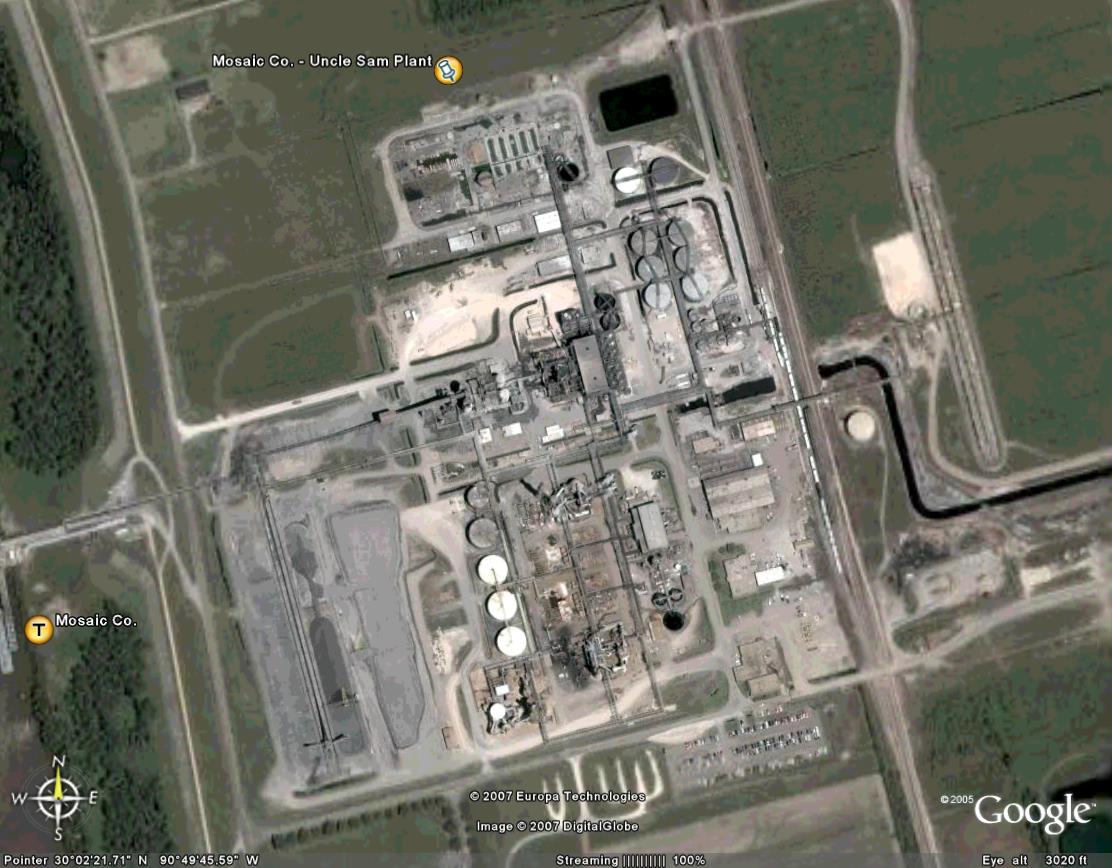
 |
|||
| General | The Uncle Sam plant was named for the Uncle Sam Plantation which was once located on the land now occupied by the plant. | |||
| References | - | |||
| News |
August 28, 2026 - The Mosaic
Company will lay off over 200 employees at two of its Louisiana facilities
due to ongoing sulfur supply constraints affecting phosphate fertilizer
production. According to a WARN notice filed on Aug. 26, the Mosaic Company
will have 206 workers laid off by Saturday, Oct. 10. Company
spokespeople said in a prepared statement that global sulfur supply
constraints and “extraordinary market conditions” led to the decision to
reduce portions of its workforce at its Uncle Sam and Faustina facilities,
located in Donaldsonville and Convent. According to the company’s
website, with more than 500 employees and contractors in Louisiana, the
company is one of the largest employers in St. James Parish. Ammonia
production at Faustina continues uninterrupted during the idling of
phosphate operations. Company officials noted the challenge was previously
disclosed in its Q2 earnings release and discussed during its earnings call.
“As previously disclosed in our Q2 earnings release and discussed during our
earnings call, Mosaic is navigating an ongoing challenge related to the
availability and cost of sulfur, an essential input for phosphate fertilizer
production,” reads a statement from the company. “The safety of our
employees, contractors, communities, and the environment remains Mosaic's
highest priority. Mosaic will continue to responsibly manage its facilities
and assets, in accordance with regulatory requirements.” The company
also plans to pursue opportunities to resume full operations as market
conditions improve, according to officials. In a letter, a
spokesperson for Mosaic said the company intends to support its employees in
the transition. "We recognize how difficult this news is for our
employees and their families. Please know that we are committed to
supporting them through this transition, with the care and safety of our
people and communities as our top priority," the letter read. September 12, 2023 - In Louisiana, an unexpected local utility power interruption at the end of August resulted in damage to the largest sulfuric acid plant at Louisiana's Uncle Sam facility. Repairs to the complex, which operates at a production rate of 15,000 finished product tonnes per week, are anticipated to be completed by the end of October. December 10, 2019 - Mosaic Co. is restarting its idled fertilizer production facilities in St. James Parish and officials hope they will be fully operational by Monday. Spokeswoman Callie Neslund said all employees furloughed during the two-month idling returned to work last week, but many of them are undergoing standard safety training following the extended break. The company halted production in St. James Parish on Oct. 1 and furloughed more than 370 employees due to an oversupply of the agriculture fertilizer that Mosaic makes along the Mississippi River, company officials said then. Though a handful of employees remained during the furlough for maintenance, the idling affected both Mosaic operations in St. James — the Uncle Sam and Faustina facilities straddling either side of the river. Neslund said the fall season was not as good as the company hoped, but the idling achieved a balance of customer demand with the company's excess inventory. "We hope to be fully operational by the 16th, but in the interim, all of the employees have returned to full-time employment," Neslund said. She said the company began the multiday process of restarting the complex on Thursday and had previously begun receiving shipments in preparation for the restart. During the plant idling, furloughed employees received at least 70% of their pay, plus all key benefits. The slowdown came as the company was responding to a slow shifting of its massive waste gypsum pile at the east bank of the Uncle Sam facility near Convent, though company officials said the plant idling was related to market conditions. The movement of the waste pile, which is about 185 feet tall and has its own nighttime warning lights for aircraft, had raised worries early this year from state and federal regulators concerned about the integrity of a large lake inside the pile. The lake holds hundreds of millions of gallons of acidic and radioactive process water. Regulators and the company now say the risk of a catastrophic failure and release of the water is minimal. The movement of parts of the pile's north wall and the earth deep beneath that wall have slowed significantly after a series of emergency measures. The movement went from more than a half-inch per day to one-tenth to one-hundredth of an inch per day, on average, state reports show. A halt in production affects the company's ability to manage the supply of the process water on site, company officials have previously said. Rainfall expands that supply while continued fertilizer production causes the water to evaporate. Company officials said at the time of the furlough that they had spare water storage capacity and other efforts underway to reduce process water levels so they could manage the water during the production halt. September 17. 2019 - Mosaic Co. is idling its Louisiana phosphates operations in St. James, cutting production by about 500,000 tons this year, as imports into the country have pushed down prices. The move is intended to speed up how fast Mosaic can empty its inventories, though the company expects “a more balanced global supply-and-demand picture to emerge by 2020.” Prices of the fertilizer ingredient have been under pressure since late 2018 as demand remains weak and capacity expansions in Morocco and Saudi Arabia have increased output and exports, Reuters reports. “Phosphate prices have declined further through the summer, with excess imports continuing to enter the U.S. on top of high channel inventories,” President and CEO Joc O’Rourke said in a statement. “We expect our move to idle production to tighten supply and rebalance the market. Mosaic will prioritize shipments to meet key customer needs through the idling period.” The company will also initiate $250 million in stock repurchases under its existing share repurchase authorization, which has $850 million of remaining capacity, according to the announcement. Mosaic operates its Faustina and Uncle Sam facilities in St. James Parish. At the Uncle Sam Facility, a turbo generator harnesses excess heat from sulfuric acid production. The cogeneration process allows Mosaic to harness “clean and green” energy. Uncle Sam produces phosphoric acid, which is then shipped across the river to the company’s Faustina facility, producing ammonia to make MAP, DAP and other products. October 1, 2015 - EPA and the U.S. Department of Justice announced a settlement with Mosaic Fertilizer, LLC that will ensure the proper treatment, storage, and disposal of an estimated 60 billion pounds of hazardous waste at six Mosaic facilities in Florida and two in Louisiana. The settlement resolves a series of alleged violations by Mosaic, one of the world’s largest fertilizer manufacturers, of the federal Resource Conservation and Recovery Act (RCRA), which provides universal guidelines for how hazardous waste must be stored, handled and disposed. The 60 billion pounds of hazardous waste addressed in this case is the largest amount ever covered by a federal or state RCRA settlement and will ensure that wastewater at Mosaic’s facilities is properly managed and does not pose a threat to groundwater resources. May 10, 2011 - The Mosaic Company today announced it will temporarily shut down its Louisiana operations due to the impact of the Mississippi River flooding on its electrical power supplies. Operations will resume when river water levels recede and conditions permit. The Company also noted that its ammonia plant at this location is temporarily idled for repairs following a recent incident. Mosaic's Louisiana operations include Faustina, which produces diammonium phosphate and ammonia, and its Uncle Sam facility, which produces phosphoric, sulfuric and fluosilicic acid. These matters are not expected to have a material impact on Mosaic's operations or financial results.
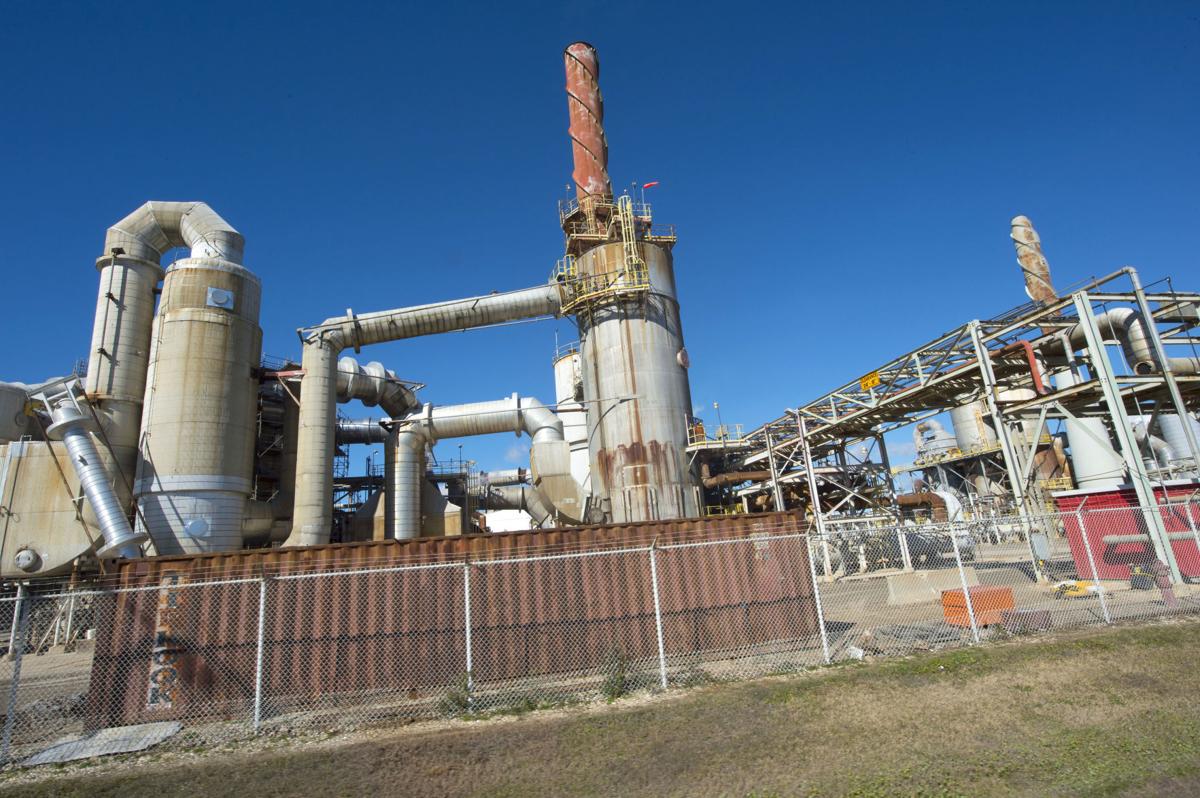
November 16, 2009 - The Mosaic Company (Mosaic) has contracted Cansolv Technologies Inc (Cansolv) an affiliate of Shell Global Solutions International B.V., to supply a modular CANSOLV SO2 Scrubbing System. The modular plant will capture SO2 from sulfuric acid plant tail gas at Mosaic’s Uncle Sam fertilizer production facility in Louisiana, USA. The CANSOLV SO2 Scrubbing System will be a key factor in enabling Mosaic to meet the SO2 reductions Mosaic has agreed to implement with its regulators. It is also the first regenerable technology of its kind to be installed in the fertilizer industry in the United States. The project award follows the successful implementation of the CANSOLV SO2 Scrubbing System in a wide range of industrial sectors with operating plants in the petrochemical, metallurgical and power industries. Mosaic has chosen to procure a pre-fabricated modular plant following an engineering study that demonstrated the cost-effectiveness of this approach. The expected delivery date of the modular plant is September 2010. The CANSOLV SO2 Scrubbing System is a new benchmark for environmental performance of sulfuric acid plants in the fertilizer industry. The technology will enable the Mosaic facility to meet SO2 emissions of 1 lb SO2/ton acid, while generating minimal liquid effluent. The Cansolv patented technology uses a regenerable amine to selectively absorb sulfur dioxide from the tail gas stream and recycles the pure SO2 by-product to the acid plant, maximizing productivity and minimizing liquid effluent.
October 10, 2009 - Mosaic Fertilizer agreed this week to give up its permit for a now-closed sulfuric acid production plant in Mulberry in partial settlement of a Clean Air Act action filed in federal court in New Orleans. It did not, as the Associated Press erroneously reported, agree to close its Bartow chemical plant, which remains in operation. The confusion, according to Russell Schweiss, public affairs manager for Mosaic, came from a reference to the Mulberry plant as being “near Bartow.” Mosaic shut down the Mulberry plant in 2008, Schweiss said. Mosaic, which has its corporate headquarters in Plymouth, Minn., is the last phosphate company still operating in Polk County. In the settlement, the company agreed to spend about $30 million to improve air pollution controls at its sulfuric acid plant near Baton Rouge, La., as well as to give up its permit for the Mulberry plant. Since that plant is closed, the settlement has no effect on any Mosaic opertions in Florida, Schweiss said. He said the upgrades at the Louisiana plant will include state-of-the-art scrubbers to capture sulfur dioxide emissions. The agreement also requires Mosaic to pay a $2.4 million civil penalty. Sulfur dioxide is emitted in the production of sulfuric acid, and in sufficient concentrations, can cause respiratory problems.
October 5, 2009
- Plymouth-based fertilizer giant Mosaic reported sharply lower profits for
the first quarter amid a global sales slowdown of crop nutrients. In a
release issued after trading closed Monday, the company reported sales of
$1.46 billion, or 66 percent below last year's first quarter sales of $4.32
billion. Earnings of $100.6 million for the quarter ending Aug. 31 were 92
percent below last year's $1.18 billion and amounted to 23 cents per share.
Analysts had expected earnings of 35 cents per share on sales of $1.54
billion. Sharp increases in fertilizer costs beginning last year,
along with falling prices for some key agriculture commodities and the
global recession, have thrown fertilizer sales into a tailspin. Mosaic's
industry rival, PotashCorp. of Saskatchewan, Inc., has scaled back its
financial guidance several times this year. Mosaic, which
produces fertilizer ingredients potash and phosphate, earlier this year
declined to issue guidance "until market conditions normalize" on
significant aspects of its business, including potash sales volumes and
selling price. Cargill, the agribusiness titan and majority
owner of Mosaic, warned in August that earnings had dropped at Mosaic. That
same month, Mosaic officials said potash sales had fallen 35 to 40 percent,
and phosphate sales were off 15 to 20 percent. The company's long-term
outlook remains positive because global demand for food, and thus the
fertilizer needed to grow it, remains strong and rising. Projections of both
population and calorie consumption show that farmers around the world must
sharply increase their production to feed the planet. "Phosphate
fundamentals have improved," said James T. Prokopanko, company president and
CEO. "The potash market is evolving and we expect strong demand in calendar
year 2010 for both nutrients."
October 5, 2009 - A Minnesota-based company accused of violating
the Clean Air Act has agreed to spend about $30 million to improve air
pollution controls at its sulfuric acid production plant in Louisiana.
A settlement agreement filed Monday in a New Orleans federal court also
calls for Mosaic Fertilizer of Plymouth, Minnesota, to pay a $2.4 million
civil penalty. The Justice Department and U.S. Environmental
Protection Agency says Mosaic agreed to install equipment that will limit
sulfur dioxide emissions at its plant in Uncle Sam, Louisiana, and will
permanently cease sulfuric acid production at its plant in Bartow, Florida. |
|||
MTPD - Metric Tonne per Day
STPD - Short Ton per Day
MTPA - Metric Tonne per Annum STPA - Short Ton per
Annum
SA - Single Absorption
DA - Double Absorption
* Coordinates can be used to
locate plant on Google Earth